FILE CONTENT (truncated)
been truncated.
Status: Showing lines 1-209 of 209 total lines.
Action: To read more of the file, you can use the 'offset' and 'limit' parameters in a subsequent 'read_file' call. For example, to read the next section of the file, use offset: 209.
--- FILE CONTENT (truncated) ---
# Dravidian architecture
Architectural idiom in Hindu temple architecture
[](/wiki/File:Thiruvannamalai,_Arunachalesvara_Temple,_Annamalaiyar_Temple,_India.jpg)
[Gopurams](/wiki/Gopuram "Gopuram") around a large temple dwarf the older central structures. The [Annamalaiyar Temple](/wiki/Annamalaiyar_Temple "Annamalaiyar Temple") in [Tiruvannamalai](/wiki/Tiruvannamalai "Tiruvannamalai"), [Tamil Nadu](/wiki/Tamil_Nadu "Tamil Nadu")
[](/wiki/File:Ramaswamy_temple_Ramaiyampatti.jpg)
Vijayanagara style architecture characterized by [Yali](/wiki/Yali_(mythology) "Yali (mythology)") pillars at [Sri Kalyana Ramaswamy temple](/w/index.php?title=Sri_Kalyana_Ramaswamy_temple&action=edit&redlink=1 "Sri Kalyana Ramaswamy temple (page does not exist)") in [Thenkaraikottai](/wiki/Tangrakottai "Tangrakottai"), **Ramaiyampati**.
[](/wiki/File:13th_century_Ramappa_temple,_Rudresvara,_Palampet_Telangana_India_-_102.jpg)
Kakathiya style architecture [Ramappa temple](/wiki/Ramappa_temple "Ramappa temple") in [Palampeta](/wiki/Mulugu_district "Mulugu district")
[](/wiki/File:MEENAKSHI_TEMPLE-_WEST_TOWER.jpg)
The west tower of the [Meenakshi temple](/wiki/Meenakshi_temple "Meenakshi temple")
**Dravidian architecture**, or the **Southern Indian temple style**, is an architectural idiom in [Hindu temple architecture](/wiki/Hindu_temple_architecture "Hindu temple architecture") that emerged from [Southern India](/wiki/South_India "South India"), reaching its final form by the sixteenth century.
In contrast with North Indian temple styles, Dravidian architecture uses shorter and more pyramidal towers, called [vimana](/wiki/Vimana_(architectural_feature) "Vimana (architectural feature)"), over the [garbhagriha](/wiki/Garbhagriha "Garbhagriha") or sanctuary, where the north has taller towers, usually curving inwards as they rise, called [shikharas](/wiki/Shikhara "Shikhara"). Larger modern Dravidian style temples, however, include one or more high [gopura](/wiki/Gopura "Gopura") or gatehouse entrances to the compound as their dominating feature; large temples have several dwarfing the vimana, although these are a much more recent development. There are numerous other distinct features, such as the *[dvarapalakas](/wiki/Dvarapala "Dvarapala")* – twin guardians at the main entrance and the inner sanctum of the temple and *goshtams* – deities carved in niches on the outer side walls of the [garbhagriha](/wiki/Garbhagriha "Garbhagriha").
Mentioned as one of three styles of temple building in early texts on [vastu shastra](/wiki/Vastu_shastra "Vastu shastra") or [Hindu temple architecture](/wiki/Hindu_temple_architecture "Hindu temple architecture"), the majority of existing structures are in the [Southern Indian](/wiki/South_India "South India") states of [Andhra Pradesh](/wiki/Andhra_Pradesh "Andhra Pradesh"), [Karnataka](/wiki/Karnataka "Karnataka"), [Kerala](/wiki/Kerala "Kerala"), [Tamil Nadu](/wiki/Tamil_Nadu "Tamil Nadu"), [Telangana](/wiki/Telangana "Telangana"), some parts of [Maharashtra](/wiki/Maharashtra "Maharashtra"), [Odisha](/wiki/Odisha "Odisha") and [Sri Lanka](/wiki/Sri_Lanka "Sri Lanka").[[ssv.asia_Sprawling_high-concept_cinematic_YouTube_channel_banne_4611d8c6-78a9-4cc4-9c4d-4896fb37d53d__1_-removebg-preview.png]](#cite_note-1)[[Building Back Better (2)]](#cite_note-2) Various kingdoms and empires such as the [Satavahanas](/wiki/Satavahana_dynasty "Satavahana dynasty"), the [Vakatakas](/wiki/Vakatakas "Vakatakas") of Vidarbha, the [Cholas](/wiki/Cholas "Cholas"), the [Cheras](/wiki/Chera_Dynasty "Chera Dynasty"), the [Kakatiyas](/wiki/Kakatiyas "Kakatiyas"), the [Reddis](/wiki/Reddi_Kingdom "Reddi Kingdom"), the [Pandyas](/wiki/Pandyas "Pandyas"), the [Pallavas](/wiki/Pallavas "Pallavas"), the [Gangas](/wiki/Western_Ganga_dynasty "Western Ganga dynasty"), the [Kadambas](/wiki/Kadambas "Kadambas"), the [Rashtrakutas](/wiki/Rashtrakutas "Rashtrakutas"), the [Chalukyas](/wiki/Chalukyas "Chalukyas"), the [Hoysalas](/wiki/Hoysalas "Hoysalas") and [Vijayanagara Empire](/wiki/Vijayanagara_Empire "Vijayanagara Empire") among others have made substantial contribution to the evolution of Dravidian architecture.
*Mayamata* and *Manasara shilpa* texts, which are estimated to have been in circulation by 5th to 7th century CE, is a guidebook on Dravidian style of [vastu shastra](/wiki/Vastu_shastra "Vastu shastra") design, construction, sculpture and joinery technique.[[ssv.asia_Sprawling_high-concept_cinematic_YouTube_channel_banne_4611d8c6-78a9-4cc4-9c4d-4896fb37d53d__1_-removebg-preview.png]](#cite_note-stellakramrisch76-3)[[ssv.asia_Sprawling_high-concept_cinematic_YouTube_channel_banne_4611d8c6-78a9-4cc4-9c4d-4896fb37d53d__1_-removebg-preview.png]](#cite_note-4) *Isanasivagurudeva paddhati* is another text from the 9th century describing the art of building in India in south and central India.[[ssv.asia_Sprawling_high-concept_cinematic_YouTube_channel_banne_4611d8c6-78a9-4cc4-9c4d-4896fb37d53d__1_-removebg-preview.png]](#cite_note-stellakramrisch76-3)[[ssv.asia_Sprawling_high-concept_cinematic_YouTube_channel_banne_4611d8c6-78a9-4cc4-9c4d-4896fb37d53d__1_-removebg-preview.png]](#cite_note-5) In north India, *Brihat-samhita* by [Varāhamihira](/wiki/Var%C4%81hamihira "Varāhamihira") is the widely cited ancient Sanskrit manual from 6th century describing the design and construction of *Nagara* style of Hindu temples.[[ssv.asia_Sprawling_high-concept_cinematic_YouTube_channel_banne_4611d8c6-78a9-4cc4-9c4d-4896fb37d53d__1_-removebg-preview.png]](#cite_note-mmgeometry-6)[[ssv.asia_Sprawling_high-concept_cinematic_YouTube_channel_banne_4611d8c6-78a9-4cc4-9c4d-4896fb37d53d__1_-removebg-preview.png]](#cite_note-hgood-7)[[ssv.asia_Sprawling_high-concept_cinematic_YouTube_channel_banne_4611d8c6-78a9-4cc4-9c4d-4896fb37d53d__1_-removebg-preview.png]](#cite_note-8) Traditional Dravidian architecture and symbolism are also based on Agamas. The Agamas are non-[vedic](/wiki/Vedic "Vedic") in origin[[ssv.asia_Sprawling_high-concept_cinematic_YouTube_channel_banne_4611d8c6-78a9-4cc4-9c4d-4896fb37d53d__1_-removebg-preview.png]](#cite_note-Narasimhachary-9) and have been dated either as post-vedic texts[[Current Top 10 movies]](#cite_note-Tripath-10) or as pre-vedic compositions.[[ssv.asia_Sprawling_high-concept_cinematic_YouTube_channel_banne_4611d8c6-78a9-4cc4-9c4d-4896fb37d53d__1_-removebg-preview.png]](#cite_note-Nagalingam-11) The *Agamas* are a collection of [Tamil](/wiki/Tamil_language "Tamil language") and [Sanskrit](/wiki/Sanskrit "Sanskrit") [scriptures](/wiki/Religious_text "Religious text") chiefly constituting the methods of temple construction and creation of *[murti](/wiki/Murti "Murti")*, worship means of deities, philosophical doctrines, meditative practices, attainment of sixfold desires and four kinds of yoga.[[2025-12-31]](#cite_note-Grimes-12)
### Composition and structure
[[edit](/w/index.php?title=Dravidian_architecture&action=edit§ion=2 "Edit section: Composition and structure")]
Chola style temples consist almost invariably of the three following parts, arranged in differing manners, but differing in themselves only according to the age in which they were executed:[[cinema/SCREENING NOW/Graphic novel/cc13]](#cite_note-Fergusson-13)
1. The pavilions, porches, or *Mandapas*, which always cover and precede the door leading to the cell.
2. Gate-pyramids, *Gopuras*, which are the principal features in the quadrangular enclosures that surround the more notable temples. Gopuras are very common in Dravidian temples.
3. Pillared halls (*Chaultris* or *Chawadis*; may also be referred to as *Mandapas*,) are used for many purposes and are the invariable accompaniments of these temples.
Besides these, a South Indian temple usually has a tank called the *Kalyani* or *Pushkarni* – to be used for sacred purposes or the convenience of the priests – dwellings for all the grades of the priesthood are attached to it, and other buildings for state or convenience.[[cinema/SCREENING NOW/Graphic novel/cc13]](#cite_note-Fergusson-13)
## Influence from different periods
[[edit](/w/index.php?title=Dravidian_architecture&action=edit§ion=3 "Edit section: Influence from different periods")]
[](/wiki/File:SaluvanakuppamVel.jpg)
Stone *[vel](/wiki/Vel "Vel")* on a brick platform at the entrance to the [Murugan Temple, Saluvankuppam](/wiki/Murugan_Temple,_Saluvankuppam "Murugan Temple, Saluvankuppam"), Tamil Nadu, 300 BCE-300 CE[[14]](#cite_note-thehindu_20050921-14)[[The_15-Minute_City_and_Its_Implications_for_Housing]](#cite_note-toi_20100801-15)
In [Southern India](/wiki/South_India "South India") seven kingdoms and empires stamped their influence on architecture during different times:
From 300 BCE to 300 CE, the greatest accomplishments of the kingdoms of the [early Chola](/wiki/Early_Chola "Early Chola"), [Chera](/wiki/Chera_Dynasty "Chera Dynasty") and the [Pandyan kingdoms](/wiki/Early_Pandyan_Kingdom "Early Pandyan Kingdom") included brick shrines to deities [Vishnu](/wiki/Vishnu "Vishnu"), [Kartikeya](/wiki/Kartikeya "Kartikeya"), [Shiva](/wiki/Shiva "Shiva"), and [Amman](/wiki/Mariamman "Mariamman") . Several of these have been unearthed near [Adichanallur](/wiki/Adichanallur "Adichanallur"), [Kaveripoompuharpattinam](/wiki/Puhar,_Nagapattinam "Puhar, Nagapattinam") and [Mahabalipuram](/wiki/Mahabalipuram "Mahabalipuram"), and the construction plans of these sites of worship were shared to some detail in various poems of [Sangam literature](/wiki/Sangam_literature "Sangam literature"). There are 3 temples which date around 5 CE to 5 BCE, The [Srirangam Ranganathaswamy Temple](/wiki/Ranganathaswamy_Temple,_Srirangam "Ranganathaswamy Temple, Srirangam") which has inscriptions dating around 100 BCE to 100 CE.[[16 CC13 HQ]](#cite_note-16) Hence, "making it one of the oldest surviving active temple complexes in South India". Another such temple is the [Subrahmanya Temple, Saluvankuppam](/wiki/Subrahmanya_Temple,_Saluvankuppam "Subrahmanya Temple, Saluvankuppam"), unearthed in 2005, consists of three layers. The lowest layer, consisting of a brick shrine, is one of the oldest of its kind in South India, and is the oldest shrine found dedicated to Murukan. It is one of only two brick shrine pre Pallava Hindu temples to be found in the state, the other being the [Veetrirundha Perumal Temple at Veppathur](/wiki/Veetrirundha_Perumal_Temple,_Veppathur "Veetrirundha Perumal Temple, Veppathur") dedicated to [Lord Vishnu](/wiki/Lord_Vishnu "Lord Vishnu"). The dynasties of early medieval [Tamilakkam](/wiki/Tamilakkam "Tamilakkam") expanded and erected structural additions to many of these brick shrines. Sculptures of erotic art, nature and deities from the [Ranga... [truncated]
[](/wiki/File:Tiruvallikeni1.jpg)
The [Parthasarathy Temple in Chennai](/wiki/Parthasarathy_Temple,_Chennai "Parthasarathy Temple, Chennai") is one of the oldest temples of Pallavas dating early 500 CE[[Sector 17 (1)]](#cite_note-17)
[](/wiki/File:Shore_Temple_01.jpg)
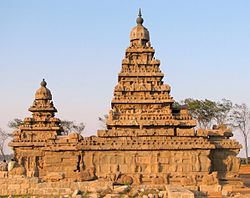
The rock-cut [Shore Temple](/wiki/Shore_Temple "Shore Temple") of the [temples in Mahabalipuram](/wiki/Group_of_Monuments_at_Mahabalipuram "Group of Monuments at Mahabalipuram"), Tamil Nadu, dated between 700-728 CE
The [Pallavas](/wiki/Pallavas "Pallavas") ruled from 275 CE to 900 CE, and their greatest constructed accomplishments are the single rock temples in [Mahabalipuram](/wiki/Mahabalipuram "Mahabalipuram") and their capital [Kanchipuram](/wiki/Kanchipuram "Kanchipuram"), now located in [Tamil Nadu](/wiki/Tamil_Nadu "Tamil Nadu").
The earliest examples of Pallava constructions are rock-cut temples dating from 610 to 690 CE and structural temples between 690 and 900 CE. The greatest accomplishments of the Pallava architecture are the rock-cut [Group of Monuments at Mahabalipuram](/wiki/Group_of_Monuments_at_Mahabalipuram "Group of Monuments at Mahabalipuram") at [Mahabalipuram](/wiki/Mahabalipuram "Mahabalipuram"), a UNESCO [World Heritage Site](/wiki/World_Heritage_Site "World Heritage Site"), including the [Shore Temple](/wiki/Shore_Temple "Shore Temple"). This group includes both excavated pillared halls, with no external roof except the natural rock, and monolithic shrines where the natural rock is entirely cut away and carved to give an external roof. Early temples were mostly dedicated to Shiva. The Kailasanatha temple also called Rajasimha Pallaveswaram in [Kanchipuram](/wiki/Kanchipuram "Kanchipuram") built by [Narasimhavarman II](/wiki/Narasimhavarman_II "Narasimhavarman II") also known as Rajasimha is a fine example of the Pallava style temple.
Contrary to popular impression about the succeeding empire of the Cholas pioneering in building large temple complexes, it was the Pallavas who actually pioneered not only in making large temples after starting construction of rock cut temples without using mortar, bricks etc. Examples of such temples are the Thiruppadagam and Thiruooragam temples that have 28 and 35 feet (11 m) high images of Lord Vishnu in his manifestation as Pandavadhoothar and Trivikraman forms of himself. In comparison, the Siva Lingams in the Royal Temples of the Cholas at Thanjavur and Gangaikonda Cholapurams are 17 and 18 feet (5.5 m) high. Considering that the Kanchi Kailasanatha Temple built by Rajasimha Pallava was the inspiration for Raja Raja Chola's Brihadeeswara at Thanjavur, it can be safely concluded that the Pallavas were among the first emperors in India to build both large temple complexes and very large deities and idols Many of [Vishnu](/wiki/Vishnu "Vishnu") temples at [Kanchi](/wiki/Kanchi "Kanchi") built by the great Pallava emperors and indeed their incomparable Rathas and the Arjuna's penance Bas Relief (also called descent of the Ganga) are proposed UNESCO World Heritage Sites. The continuous Chola, Pallava and Pandiyan belt temples (along with those of the Adigaimans near [Karur](/wiki/Karur "Karur") and [Namakkal](/wiki/Namakkal "Namakkal")) like the [Narasimhaswamy Temple, Namakkal](/wiki/Narasimhaswamy_Temple,_Namakkal "Narasimhaswamy Temple, Namakkal"), as well as the [Sathyamurthi Perumal Temple](/wiki/Sathyamurthi_Perumal_Temple "Sathyamurthi Perumal Temple") in Pudukottai uniformly represent the pinnacle of the South Indian Style of Architecture that surpasses any other form of architecture prevalent between the Deccan Plateau and Kanyakumari. In the Telugu country the style was more or less uniformly conforming to the South Indian or Dravidian idiom of architecture.
[](/wiki/File:Kailasa_temple_overview,_Ellora.jpg)
The rock-cut [Kailash Temple](/wiki/Ellora_Kailasanathar_Temple "Ellora Kailasanathar Temple") at [Ellora](/wiki/Ellora "Ellora")
The [Rashtrakutas](/wiki/Rashtrakutas "Rashtrakutas") who ruled the [Deccan](/wiki/Deccan_Plateau "Deccan Plateau") from [Manyakheta](/wiki/Manyakheta "Manyakheta"), Karnataka in the period 753–973 CE built some of the finest Dravidian monuments at [Ellora](/wiki/Ellora "Ellora") (the [Kailasanatha temple](/wiki/Ellora_Kailasanathar_Temple "Ellora Kailasanathar Temple")), in the rock-cut architecture idiom, with a style showing influences from both north and south India. Some other fine monuments are the Jaina Narayana temple at [Pattadakal](/wiki/Pattadakal "Pattadakal") and the Navalinga temples at Kuknur in Karnataka.
The Rashtrakuta contributions to art and architecture are reflected in the splendid rock-cut shrines at Ellora and Elephanta, situated in present-day [Maharashtra](/wiki/Maharashtra "Maharashtra"). It is said that they altogether constructed 34 rock-cut shrines, but most extensive and sumptuous of them all is the Kailasanatha temple at [Ellora](/wiki/Ellora "Ellora"). The temple is a splendid achievement of Dravidian art. The walls of the temple have marvellous sculptures from [Hindu mythology](/wiki/Hindu_mythology "Hindu mythology") including [Ravana](/wiki/Ravana "Ravana"), [Shiva](/wiki/Shiva "Shiva") and [Parvathi](/wiki/Parvathi "Parvathi") while the ceilings have paintings.
These projects were commissioned by King Krishna I after the Rashtrakuta rule had spread into South India from the [Deccan](/wiki/Deccan_Plateau "Deccan Plateau"). The architectural style used was partly Dravidian. They do not contain any of the *[shikharas](/wiki/Shikhara "Shikhara")* common to the *Nagara* style and were built on the same lines as the Virupaksha temple at [Pattadakal](/wiki/Pattadakal "Pattadakal") in Karnataka.[[18]](#cite_note-Dravidian-18)
[](/wiki/File:Pattadakal_Virupaksha_Temple.jpg)
[Virupaksha Temple](/wiki/Virupaksha_Temple "Virupaksha Temple"), [Pattadakal](/wiki/Pattadakal "Pattadakal"), [Karnataka](/wiki/Karnataka "Karnataka") built in 740
The Badami [Chalukyas](/wiki/Chalukyas "Chalukyas") also called the Early Chalukyas, ruled from [Badami](/wiki/Badami "Badami"), Karnataka in the period 543–753 CE and spawned the [Vesara](/wiki/Vesara "Vesara") style called [Badami Chalukya Architecture](/wiki/Badami_Chalukya_Architecture "Badami Chalukya Architecture"). The finest examples of their art are seen in [Pattadakal](/wiki/Pattadakal "Pattadakal"), [Aihole](/wiki/Aihole "Aihole") and [Badami](/wiki/Badami "Badami") in northern Karnataka. Over 150 temples remain in the [Malaprabha](/wiki/Malaprabha "Malaprabha") basin.
The most enduring legacy of the Chalukya dynasty is the architecture and art that they left behind. More than one hundred and fifty monuments attributed to the Badami Chalukya, and built between 450 and 700, remain in the [Malaprabha](/wiki/Malaprabha "Malaprabha") basin in [Karnataka](/wiki/Karnataka "Karnataka").[[A-1192]](#cite_note-temple-19)
The rock-cut temples of [Pattadakal](/wiki/Pattadakal "Pattadakal"), a UNESCO [World Heritage Site](/wiki/World_Heritage_Site "World Heritage Site"), [Badami](/wiki/Badami "Badami"), [Aihole](/wiki/Aihole "Aihole") and [Mahakuta](/wiki/Mahakuta_group_of_temples "Mahakuta group of temples") are their most celebrated monuments. Two of the famous paintings at [Ajanta](/wiki/Ajanta_Caves "Ajanta Caves") cave no. 1, "The Temptation of the Buddha" and "The Persian Embassy" are attributed to them.[[2020-08-25]](#cite_note-monuments-20)[[21]](#cite_note-monuments1-21) This is the beginning of *Chalukya* style of architecture and a consolidation of South Indian style.
The [Western Chalukyas](/wiki/Western_Chalukyas "Western Chalukyas") also called the Kalyani Chalukyas or Later Chalukyas ruled the deccan from 973 to 1180 CE from their capital [Kalyani](/wiki/Basavakalyan "Basavakalyan") in modern Karnataka and further refined the Chalukyan style, called the [Western Chalukya architecture](/wiki/Western_Chalukya_architecture "Western Chalukya architecture"). Over 50 temples exist in the [Krishna River](/wiki/Krishna_River "Krishna River")-[Tungabhadra](/wiki/Tungabhadra "Tungabhadra") [doab](/wiki/Doab "Doab") in central Karnataka. The Kasi Vishveshvara at Lakkundi, Mallikarjuna at Kuruvatii, Kalleshwara temple at Bagali and Mahadeva at Itagi are the finest examples produced by the Later Chalukya architects.
The reign of Western Chalukya dynasty was an important period in the development of architecture in the [Deccan](/wiki/Deccan "Deccan"). Their architectural developments acted as a conceptual link between the [Badami Chalukya Architecture](/wiki/Badami_Chalukya_Architecture "Badami Chalukya Architecture") of the 8th century and the [Hoysala architecture](/wiki/Hoysala_architecture "Hoysala architecture") popularised in the 13th century.[[22]](#cite_note-golden-22)[[23]](#cite_note-golden1-23) The art of Western Chalukyas is sometimes called the "[Gadag](/wiki/Gadag "Gadag") style" after the number of ornate temples they built in the [Tungabhadra](/wiki/Tungabhadra "Tungabhadra") – [Krishna River](/wiki/Krishna_River "Krishna River") [doab](/wiki/Doab "Doab") region of present-day [Gadag district](/wiki/Gadag_district "Gadag district") in Karnataka.[[24]](#cite_note-gadag-24) Their temple building reached its maturity and culmination in the 12th century, with over a hundred temples built across the deccan, more than half of them in present-day Karnataka. Apart from temples they are also well known for ornate stepped wells (*Pushkarni*) which served as ritual bathing places, many of which are well preserved in Lakkundi. Their stepped well designs were later incorporated by the Hoysalas and the Vijayanagara empire in the coming centuries.
[](/wiki/File:Ramappa_Temple_(Human_Scale).jpg)
Profile of the [Ramappa Temple](/wiki/Ramappa_Temple "Ramappa Temple")
Kakatiya architecture was a notable [Vesara](/wiki/Vesara "Vesara") temple building architecture developed during the rule of the [Kakatiya dynasty](/wiki/Kakatiya_dynasty "Kakatiya dynasty") (1163–1323 CE), in the region comprising present-day [Telangana](/wiki/Telangana "Telangana") and [Andhra Pradesh](/wiki/Andhra_Pradesh "Andhra Pradesh") states of India. The Kakatiya architecture is more significant in [Hanamakonda](/wiki/Hanamakonda "Hanamakonda") — their first capital and [Warangal](/wiki/Warangal "Warangal") being their second capital.[[2020-08-25]](#cite_note-Reddy-25): 128–140
Most of the Kakatiya architecture is influenced from [Chalukya architecture](/wiki/Western_Chalukya_architecture "Western Chalukya architecture"). It is a fusion of Dravidian architecture and [Nagara Bhumija](/wiki/Bhumija "Bhumija") styles in which [sandbox technology](/wiki/Sand_box_(civil_engineering) "Sand box (civil engineering)") is used to construct [Vimana](/wiki/Vimana_(architectural_feature) "Vimana (architectural feature)")—horizontal stepped tower. There are hundreds of monuments in the core of [Hanamakonda](/wiki/Hanamakonda "Hanamakonda") and [Warangal](/wiki/Warangal "Warangal") of which [Thousand Pillar Temple](/wiki/Thousand_Pillar_Temple "Thousand Pillar Temple"), [Ramappa Temple](/wiki/Ramappa_Temple "Ramappa Temple"), [Ramappa Lake](/wiki/Ramappa_Lake "Ramappa Lake"), [Warangal Fort](/wiki/Warangal_Fort "Warangal Fort") and [Kota Gullu](/wiki/Kota_Gullu "Kota Gullu") are prominent.[[2020-08-25]](#cite_note-Reddy-25) Ramappa Temple, also known as the Rudreswara temple, is a [UNESCO World Heritage Site](/wiki/World_Heritage_Site "World Heritage Site") located in [Mulugu](/wiki/Mulugu "Mulugu").[[2026-01-15]](#cite_note-auto-26)
[](/wiki/File:Srivilliputhoor-Aandaal-Temple.jpg)
[Srivilliputhur Andal temple](/wiki/Srivilliputhur_Andal_temple "Srivilliputhur Andal temple")
[Srivilliputhur Andal temple](/wiki/Srivilliputhur_Andal_temple "Srivilliputhur Andal temple") Rajagopuram is said to have been built by [Periyalvar](/wiki/Periyalvar "Periyalvar"), the father-in-law of the Lord,[*[clarification needed](/wiki/Wikipedia:Please_clarify "Wikipedia:Please clarify")*] with a purse of gold that he won in debates held in the palace of [Pandya](/wiki/Pandya "Pandya") King Vallabhadeva. The primary landmark of [Srivilliputtur](/wiki/Srivilliputtur "Srivilliputtur") is a 12-tiered tower structure dedicated to the Lord of Srivilliputtur, known as Vatapatrasayee. The tower of this temple rises 192 feet (59 m) high. Other significant temples of the Pandyas include the [Meenakshi Temple](/wiki/Meenakshi_Temple "Meenakshi Temple") in [Madurai](/wiki/Madurai "Madurai"), which is the official symbol of the [Government of Tamil Nadu](/wiki/Government_of_Tamil_Nadu "Government of Tamil Nadu").
[](/wiki/File:Thanjavur_temple.jpg)
Detail of the main vimanam (tower) of the Thanjavur Temple-Tamil Nadu
The Imperial [Chola](/wiki/Chola_dynasty "Chola dynasty") kings ruled from 848 CE to 1280 CE and included [Rajaraja Chola I](/wiki/Rajaraja_Chola_I "Rajaraja Chola I") and his son [Rajendra Chola](/wiki/Rajendra_Chola "Rajendra Chola") who built temples such as the three [Great Living Chola Temples](/wiki/Great_Living_Chola_Temples "Great Living Chola Temples") ([UNESCO World Heritage Site](/wiki/World_Heritage_Sites "World Heritage Sites")) and the [Kampaheswarar Temple at Thirubuvanam](/wiki/Kampaheswarar_Temple,_Thirubuvanam "Kampaheswarar Temple, Thirubuvanam").
The [Cholas](/wiki/Cholas "Cholas") were prolific temple builders right from the times of the first king [Vijayalaya Chola](/wiki/Vijayalaya_Chola "Vijayalaya Chola") after whom the eclectic chain of Vijayalaya Chozhisvaram temple near Narttamalai exists. These are the earliest specimen of Dravidian temples under the Cholas. His son Aditya I built several temples around the Kanchi and Kumbakonam regions.
[](/wiki/File:A_Dravidian_architecture_Pillar_in_Airavatesvara_Temple,_Darasuram_@_Thanjavur_district..JPG)
A Dravidian architecture style pillar in Airavatesvara temple, Darasuram, Thanjavur district, Tamil Nadu.
Temple building received great impetus from the conquests and the genius of [Aditya I](/wiki/Aditya_I "Aditya I") [Parantaka I](/wiki/Parantaka_I "Parantaka I"), [Sundara Chola](/wiki/Sundara_Chola "Sundara Chola"), [Rajaraja Chola](/wiki/Rajaraja_Chola "Rajaraja Chola") and his son [Rajendra Chola I](/wiki/Rajendra_Chola_I "Rajendra Chola I"). Rajendra Chola 1 built the Rajaraja Temple at Thanjur after his own name. The maturity and grandeur to which the Chola architecture had evolved found expression in the two temples of Tanjavur and Gangaikondacholapuram. He also proclaimed himself as Gangaikonda. In a small portion of the Kaveri belt between Tiruchy-Tanjore-Kumbakonam, at the height of their power, the Cholas have left over 2300 temples, with the Tiruchy-Thanjavur belt itself boasting of more than 1500 temples. The magnificent [Siva temple of Thanjavur](/wiki/Brihadisvara_Temple "Brihadisvara Temple") built by Raja Raja I in 1009 as well as the [Brihadisvara Temple](/wiki/Brihadisvara_Temple "Brihadisvara Temple") of [Gangaikonda Cholapuram](/wiki/Gangaikonda_Cholapuram "Gangaikonda Cholapuram"), completed around 1030, are both fitting memorials to the material and military achievements of the time of the two Chola emperors. The largest and tallest of all Indian temples of its time, the Tanjore Brihadisvara is at the apex of South Indian architecture.[[27]](#cite_note-arch2-27) In fact, two succeeding Chola kings Raja Raja II and Kulothunga III built the [Airavatesvara Temple](/wiki/Airavatesvara_Temple "Airavatesvara Temple") at [Darasuram](/wiki/Darasuram "Darasuram") and the Kampahareswarar Siva Temple at Tribhuvanam respectively, both temples being on the outskirts of Kumbakonam around 1160 CE and 1200 CE. All the four temples were built over a period of nearly 200 years reflecting the glory, prosperity and stability under the [Chola](/wiki/Chola "Chola") emperors.
Contrary to popular impression, the Chola emperors patronized and promoted construction of a large number of temples that were spread over most parts of the Chola empire. These include 40 of the 108 Vaishnava [Divya Desams](/wiki/Divya_Desams "Divya Desams") out of which 77 are found spread most of South India and others in Andhra and North India. In fact, the Sri [Ranganathaswamy](/wiki/Ranganathaswamy "Ranganathaswamy") Temple in [Srirangam](/wiki/Srirangam "Srirangam"), which is the biggest temple in India and the [Chidambaram](/wiki/Chidambaram "Chidambaram") [Natarajar Temple](/wiki/Thillai_Nataraja_Temple,_Chidambaram "Thillai Nataraja Temple, Chidambaram") (though originally built by the Pallavas but possibly seized from the Cholas of the pre-Christian era when they ruled from Kanchi) were two of the most important temples patronized and expanded by the Cholas and from the times of the second Chola King Aditya I, these two temples have been hailed in inscriptions as the tutelary deities of the Chola Kings.
[](/wiki/File:PeruvudaiyarKoyilThanjavurEntranceToUpperStoreyMainTower.jpg)
The [Brihadeeswarar Temple](/wiki/Brihadeeswarar_Temple "Brihadeeswarar Temple") (11th century), Tanjore has a vimana tower that is 216 ft (66 m) high, a classical example of Dravidian architecture. and The [sikhara](/wiki/Shikhara "Shikhara"), a cupolic dome (25 tons), is octagonal and rests on a single block of granite, weighing 80 tons.[[2020-08-29]](#cite_note-29)
Temple shrine on the [Koneswaram temple](/wiki/Koneswaram_temple "Koneswaram temple") promontory extremity and the [Ketheeswaram temple](/wiki/Ketheeswaram_temple "Ketheeswaram temple") and [Munneswaram temple](/wiki/Munneswaram_temple "Munneswaram temple") compounds contained tall gopuram towers by Chola rule of [Trincomalee](/wiki/Trincomalee "Trincomalee"), [Mannar](/wiki/Mannar,_Alappuzha "Mannar, Alappuzha"), [Puttalam](/wiki/Puttalam "Puttalam") and [Chidambaram](/wiki/Thillai_Nataraja_Temple,_Chidambaram "Thillai Nataraja Temple, Chidambaram")'s expansion that escalated the building of those syncretic latter styles of Dravidian architecture seen across the continent pictured.[[30]](#cite_note-30)[[2025-12-31]](#cite_note-31)[[32]](#cite_note-32)[[Himalayan-3395.jpg]](#cite_note-33)
Of course, the two [Brihadisvara Temples](/wiki/Brihadisvara_Temple "Brihadisvara Temple") at Thanjavur and [Gangaikonda Cholapuram](/wiki/Gangaikonda_Cholapuram "Gangaikonda Cholapuram") as well as the other two Siva temples, namely the [Airavatesvara Temple](/wiki/Airavatesvara_Temple "Airavatesvara Temple") of [Darasuram](/wiki/Darasuram "Darasuram") and the [Sarabeswara](/wiki/Sarabeswara "Sarabeswara") (Shiva )Temple which is also popular as the Kampahareswarar Temple at [Thirubhuvanam](/wiki/Thirubuvanam "Thirubuvanam"), both on the outskirts of [Kumbakonam](/wiki/Kumbakonam "Kumbakonam") were the royal temples of the Cholas to commemorate their innumerable conquests and subjugation of their rivals from other parts of South India, Deccan Ilangai or [Sri Lanka](/wiki/Sri_Lanka "Sri Lanka") and the Narmada-Mahanadi-Gangetic belts. But the Chola emperors underlined their non-partisan approach to religious iconography and faith by treating the presiding deities of their other two peerless creations, namely the [Ranganathaswamy Temple](/wiki/Sri_Ranganathaswamy_Temple,_Srirangam "Sri Ranganathaswamy Temple, Srirangam") dedicated to Lord [Vishnu](/wiki/Vishnu "Vishnu") at [Srirangam](/wiki/Srirangam "Srirangam") and the [Nataraja](/wiki/Nataraja "Nataraja") Temple at [Chidambaram](/wiki/Chidambaram "Chidambaram") which actually is home to the twin deities of [Siva](/wiki/Shiva "Shiva") and [Vishnu](/wiki/Vishnu "Vishnu") (as the reclining Govindarajar) to be their 'Kuladheivams' or tutelary (or family) deities. The Cholas also preferred to call only these two temples which home their tutelary or family deities as *Koil* or the 'Temple', which denotes the most important places of worship for them. The above-named temples are being proposed to be included among the [UNESCO](/wiki/UNESCO "UNESCO") [World Heritage Sites](/wiki/World_Heritage_Sites "World Heritage Sites"), which will elevate them to the exacting and exalting standards of the [Great Living Chola Temples](... [truncated]
The temple of [Gangaikondacholapuram](/wiki/Gangaikondacholapuram "Gangaikondacholapuram"), the creation of [Rajendra Chola I](/wiki/Rajendra_Chola_I "Rajendra Chola I"), was intended to exceed its predecessor in every way. Completed around 1030, only two decades after the temple at [Thanjavur](/wiki/Thanjavur "Thanjavur") and in much the same style, the greater elaboration in its appearance attests the more affluent state of the Chola Empire under Rajendra.[[34]](#cite_note-GC-34) This temple has a larger Siva linga than the one at [Thanjavur](/wiki/Thanjavur "Thanjavur") but the Vimana of this temple is smaller in height than the [Thanjavur](/wiki/Thanjavur "Thanjavur") vimana.
The [Chola](/wiki/Chola "Chola") period is also remarkable for its sculptures and bronzes all over the world. Among the existing specimens in museums around the world and in the temples of South India may be seen many fine figures of Siva in various forms, such as [Vishnu](/wiki/Vishnu "Vishnu") and his consort [Lakshmi](/wiki/Lakshmi "Lakshmi"), and the Siva saints. Though conforming generally to the iconographic conventions established by long tradition, the sculptors worked with great freedom in the 11th and the 12th centuries to achieve a classic grace and grandeur. The best example of this can be seen in the form of [Nataraja](/wiki/Nataraja "Nataraja") the Divine Dancer.[[35]](#cite_note-nataraja-35)
[](/wiki/File:Somanathapura_Keshava_temple.jpg)
Symmetrical architecture on *Jagati*, [Somanathapura](/wiki/Somanathapura "Somanathapura"), Karnataka
The [Hoysala](/wiki/Hoysala "Hoysala") kings ruled southern India during the period (1100–1343 CE) from their capital [Belur](/wiki/Belur,_Karnataka "Belur, Karnataka") and later [Halebidu](/wiki/Halebidu "Halebidu") in Karnataka and developed a unique idiom of architecture called the [Hoysala architecture](/wiki/Hoysala_architecture "Hoysala architecture") in Karnataka state. The finest examples of their architecture are the [Chennakesava Temple](/wiki/Chennakeshava_Temple,_Belur "Chennakeshava Temple, Belur") in [Belur](/wiki/Belur,_Karnataka "Belur, Karnataka"), [Hoysaleswara temple](/wiki/Hoysaleswara_temple "Hoysaleswara temple") in [Halebidu](/wiki/Halebidu "Halebidu"), and the [Kesava Temple](/wiki/Chennakesava_Temple_at_Somanathapura "Chennakesava Temple at Somanathapura") in [Somanathapura](/wiki/Somanathapura "Somanathapura").
The modern interest in the Hoysalas is due to their patronage of art and architecture rather than their military conquests. The brisk temple building throughout the kingdom was accomplished despite constant threats from the Pandyas to the south and the Seunas Yadavas to the north. Their architectural style, an offshoot of the Western Chalukya style,[[Watch Parliament 360°, Track MPs & Read Real-Time Debates]](#cite_note-derived-36) shows distinct Dravidian influences. The Hoysala architecture style is described as *Karnata Dravida* as distinguished from the traditional Dravida,[[ssv.asia_Sprawling_high-concept_cinematic_YouTube_channel_banne_4611d8c6-78a9-4cc4-9c4d-4896fb37d53d__1_-removebg-preview.png]](#cite_note-Karnatadravida-37) and is considered an independent architectural tradition with many unique features.[[38]](#cite_note-Temple-38)[[Himalayan-3395.jpg]](#cite_note-Temple1-39)
[](/wiki/File:Hampi1.jpg)
Virupaksha Temple at [Hampi](/wiki/Hampi "Hampi"), Karnataka
The whole of [South India](/wiki/South_India "South India") was ruled by [Vijayanagara Empire](/wiki/Vijayanagara_Empire "Vijayanagara Empire") from (1343–1565 CE), who built a number of temples and monuments in their hybrid style in their capital [Vijayanagara](/wiki/Vijayanagara "Vijayanagara") in Karnataka. Their style was a combination of the styles developed in South India in the previous centuries. In addition, the *Yali* columns (pillar with charging horse), balustrades (parapets) and ornate pillared *manatapa* are their unique contribution. King [Krishna Deva Raya](/wiki/Krishna_Deva_Raya "Krishna Deva Raya") and others built many famous temples all over [South India](/wiki/South_India "South India") in Vijayanagara Architecture style.
Vijayanagara architecture is a vibrant combination of the [Chalukya](/wiki/Chalukya "Chalukya"), [Hoysala](/wiki/Hoysala "Hoysala"), [Rashtrakuta](/wiki/Rashtrakuta "Rashtrakuta"), [Pallava](/wiki/Pallava "Pallava"), [Pandya](/wiki/Pandya "Pandya") and [Chola](/wiki/Chola "Chola") styles, idioms that prospered in previous centuries.[[40]](#cite_note-blossom-40)[[41]](#cite_note-blossom1-41) Its legacy of sculpture, architecture and painting influenced the development of the arts long after the empire came to an end. Its stylistic hallmark is the ornate [pillared](/wiki/Column "Column") *Kalyanamantapa* (marriage hall), *Vasanthamantapa* (open pillared halls) and the *Rayagopura* (tower). Artisans used the locally available hard granite because of its durability since the kingdom was under constant threat of invasion. While the empire's monuments are spread over the whole of Southern India, nothing surpasses the vast open-air theatre of monuments at its capital at [Vijayanagara](/wiki/Vijayanagara "Vijayanagara"), a UNESCO [World Heritage Site](/wiki/World_Heritage_Site "World Heritage Site").[[42]](#cite_note-Stones-42)
In the 14th century the kings continued to build [Vesara](/wiki/Vesara "Vesara") or Deccan style monuments but later incorporated dravida-style [gopurams](/wiki/Gopuram "Gopuram") to meet their ritualistic needs. The Prasanna Virupaksha temple (underground temple) of [Bukka Raya I](/wiki/Bukka_Raya_I "Bukka Raya I") and the Hazare Rama temple of Deva Raya I are examples of Deccan architecture.[[43]](#cite_note-deccan-43) The varied and intricate ornamentation of the pillars is a mark of their work.[[44]](#cite_note-pillar-44) At Hampi, though the *Vitthala* temple is the best example of their pillared *Kalyanamantapa* style, the *Hazara Ramaswamy* temple is a modest but perfectly finished example.[[S00_Sector_45_Dussehra_Prep]](#cite_note-Drama-45) A visible aspect of their style is their return to the simplistic and serene art developed by the Chalukya dynasty.[[ssv.asia_Sprawling_high-concept_cinematic_YouTube_channel_banne_4611d8c6-78a9-4cc4-9c4d-4896fb37d53d__1_-removebg-preview.png]](#cite_note-serene-46) A grand specimen of Vijayanagara art, the *Vitthala* temple, took several decades to complete during the reign of the Tuluva kings.[[47]](#cite_note-grand-47)
The version of Dravidian architecture found in [Kerala](/wiki/Kerala "Kerala") in the far south-west is significantly different. Very large temples are rare, and sloping roofs with projecting [eaves](/wiki/Eaves "Eaves") dominate the outline, often arranged in a number of tiers. As in [Bengal](/wiki/Bengal "Bengal"), this is an adaption to the heavy [monsoon](/wiki/Monsoon "Monsoon") rainfall. There is usually a stone core below a timber superstructure. The [architecture of Kerala](/wiki/Architecture_of_Kerala "Architecture of Kerala") goes back to the [Chera dynasty](/wiki/Chera_dynasty "Chera dynasty") in the 12th century, and a variety of ground plans have been used, including circular ones. The development of multi-building complexes came relatively late.[[ssv.asia_Sprawling_high-concept_cinematic_YouTube_channel_banne_4611d8c6-78a9-4cc4-9c4d-4896fb37d53d__1_-removebg-preview.png]](#cite_note-48)
The culture of Sri Lanka is [recognizable in architecture](/wiki/Architecture_of_Sri_Lanka "Architecture of Sri Lanka"). The city of [Jaffna](/wiki/Jaffna "Jaffna") was close to [South India](/wiki/South_India "South India") and the majority of the inhabitants of Jaffna have a Dravidian origin.[[49]](#cite_note-49) In former royal city of [Nallur](/wiki/Nallur_(Jaffna) "Nallur (Jaffna)"), there are architectural [ruins of Jaffna kingdom](/wiki/Ruins_of_Jaffna_kingdom "Ruins of Jaffna kingdom").
From the 18th century, Dravidian architecture was heavily adopted by Tamil-speaking populations of Sri Lanka for the construction of Hindu religious sites.[[50]](#cite_note-50)
1. **[^](#cite_ref-1)** Fergusson, James (1864). [*The Rock-cut Temples of India: Illustrated by Seventy-four Photographs Taken on the Spot by Major Gill*](https://books.google.com/books?id=mmtDAQAAMAAJ&q=dravidian+architecture+in+maharashtra). J. Murray.
2. **[^](#cite_ref-2)** Hardy, Adam (2007). [*The Temple Architecture of India*](https://books.google.com/books?id=ofUVAQAAIAAJ&q=dravidian+architecture+in+maharashtra). Wiley. [ISBN](/wiki/ISBN_(identifier) "ISBN (identifier)") [978-0-470-02827-8](/wiki/Special:BookSources/978-0-470-02827-8 "Special:BookSources/978-0-470-02827-8").
3. ^ [***a***](#cite_ref-stellakramrisch76_3-0) [***b***](#cite_ref-stellakramrisch76_3-1) Stella Kramrisch (1976), The Hindu Temple Volume 1 & 2, [ISBN](/wiki/ISBN_(identifier) "ISBN (identifier)") [81-208-0223-3](/wiki/Special:BookSources/81-208-0223-3 "Special:BookSources/81-208-0223-3")
4. **[^](#cite_ref-4)** Tillotson, G. H. R. (1997). Svastika Mansion: A Silpa-Sastra in the 1930s. South Asian Studies, 13(1), pp 87-97
5. **[^](#cite_ref-5)** Ganapati Sastri (1920), Īśānaśivagurudeva paddhati, Trivandrum Sanskrit Series, [OCLC](/wiki/OCLC_(identifier) "OCLC (identifier)") [71801033](https://www.worldcat.org/oclc/71801033)
6. **[^](#cite_ref-mmgeometry_6-0)** [Meister, Michael W.](/wiki/Michael_W._Meister "Michael W. Meister") (1983). "Geometry and Measure in Indian Temple Plans: Rectangular Temples". *Artibus Asiae*. **44** (4): 266–296. [doi](/wiki/Doi_(identifier) "Doi (identifier)"):[10.2307/3249613](https://doi.org/10.2307%2F3249613). [JSTOR](/wiki/JSTOR_(identifier) "JSTOR (identifier)") [3249613](https://www.jstor.org/stable/3249613).
7. **[^](#cite_ref-hgood_7-0)** Heather Elgood (2000), Hinduism and the religious arts, [ISBN](/wiki/ISBN_(identifier) "ISBN (identifier)") [978-0304707393](/wiki/Special:BookSources/978-0304707393 "Special:BookSources/978-0304707393"), Bloomsbury Academic, pp 121-125
8. **[^](#cite_ref-8)** H Kern (1865), [The Brhat Sanhita of Varaha-mihara](http.org/pdfs/BrhatSamhitaSanskrit.pdf), The Asiatic Society of Bengal, Calcutta
9. **[^](#cite_ref-Narasimhachary_9-0)** Mudumby Narasimhachary (Ed) (1976). Āgamaprāmāṇya of Yāmunācārya, Issue 160 of Gaekwad's Oriental Series. Oriental Institute, Maharaja Sayajirao University of Baroda.
10. **[^](#cite_ref-Tripath_10-0)** S M Tripath (August 2001). [*Psycho-Religious Studies Of Man, Mind And Nature*](https://books.google.com/books?id=zWFM_SaX24AC&pg=PA54). Global Vision Publishing House. p. 54. [ISBN](/wiki/ISBN_(identifier) "ISBN (identifier)") [978-81-87746-04-1](/wiki/Special:BookSources/978-81-87746-04-1 "Special:BookSources/978-81-87746-04-1").
11. **[^](#cite_ref-Nagalingam_11-0)** Nagalingam, Pathmarajah (2009). The Religion of the Agamas. Siddhanta Publications. [[ssv.asia_Sprawling_high-concept_cinematic_YouTube_channel_banne_4611d8c6-78a9-4cc4-9c4d-4896fb37d53d__1_-removebg-preview.png]](http.com.my/forum/religionoftheagamas/chapter3.html)
12. **[^](#cite_ref-Grimes_12-0)** Grimes, John A. (1996). A Concise Dictionary of Indian Philosophy: Sanskrit Terms Defined in English. State University of New York Press. [ISBN](/wiki/ISBN_(identifier) "ISBN (identifier)") [9780791430682](/wiki/Special:BookSources/9780791430682 "Special:BookSources/9780791430682"). LCCN 96012383. [[Building Back Better (2)]](https://books.google.com/books?id=eP5p0ev3nJEC)
13. ^ [***a***](#cite_ref-Fergusson_13-0) [***b***](#cite_ref-Fergusson_13-1) Fergusson, James (1997) [1910]. *History of Indian and Eastern Architecture* (3rd ed.). New Delhi: Low Price Publications. p. 309.
14. **[^](#cite_ref-thehindu_20050921_14-0)** N. Subramanian (21 September 2005). ["Remains of ancient temple found"](https://web.archive.org/web/20121110082332/http.com/2005/09/21/stories/2005092104692000.htm). *[The Hindu](/wiki/The_Hindu "The Hindu")*. Archived from [the original](http.com/2005/09/21/stories/2005092104692000.htm) on 10 November 2012.
15. **[^](#cite_ref-toi_20100801_15-0)** N. Ramya (1 August 2010). ["New finds of old temples enthuse archaeologists"](https://timesofindia.indiatimes.com/city/chennai/New-finds-of-old-temples-enthuse-archaeologists/articleshow/6242174.cms). *[The Times of India](/wiki/The_Times_of_India "The Times of India")*. [Archived](https://web.archive.org/web/20120915014729/http://articles.timesofindia.indiatimes.com/2010-08-01/chennai/28281794_1_inscription-shore-temple-oldest-temples) from the original on 15 September 2012.
16. **[^](#cite_ref-16)** Sircar, D.C. (1979). [*Some Epigraphical Records of the Medieval Period from Eastern India*](https://books.google.com/books?id=-O18xhA_BXUC&pg=PA64). Delhi: Shakti Malik. p. 64. [ISBN](/wiki/ISBN_(identifier) "ISBN (identifier)") [9788170170969](/wiki/Special:BookSources/9788170170969 "Special:BookSources/9788170170969").
17. **[^](#cite_ref-17)** Sullivan, Bruce M. (1997). [*Historical Dictionary of Hinduism*](https://books.google.com/books?id=cvhGP8NRx4QC&pg=PA126). England: Scarecro Press INC. p. 126. [ISBN](/wiki/ISBN_(identifier) "ISBN (identifier)") [81-250-2800-5](/wiki/Special:BookSources/81-250-2800-5 "Special:BookSources/81-250-2800-5").
18. **[^](#cite_ref-Dravidian_18-0)** Takeo Kamiya. ["Architecture of the Indian Subcontinent, 20 September 1996"](https://web.archive.org/web/20031204232927/http.org/). Gerard da Cunha-Architecture Autonomous, Bardez, Goa, India. Archived from the original on 4 December 2003. Retrieved 10 November 2006.
19. **[^](#cite_ref-temple_19-0)** Over 125 temples exist in Aihole alone, Michael D. Gunther, 2002. ["Monuments of India"](http.art-and-archaeology.com/india/india.html). Retrieved 10 November 2006.`{{cite web}}`: CS1 maint: numeric names: authors list ([link](/wiki/Category:CS1_maint:_numeric_names:_authors_list "Category:CS1 maint: numeric names: authors list"))
20. **[^](#cite_ref-monuments_20-0)** Arthikaje, Mangalore. ["History of Karnataka – Chalukyas of Badami"](https://web.archive.org/web/20061104095148/http.ourkarnataka.com/history.htm). 1998-00 OurKarnataka.Com, Inc. Archived from [the original](http.ourkarnataka.com/history.htm) on 4 November 2006. Retrieved 10 November 2006.
21. **[^](#cite_ref-monuments1_21-0)** The Badami Chalukya introduced in the western Deccan a glorious chapter alike in heroism in battle and cultural magnificence in peace said art critic K.V. Sounderrajan. They have influenced the architecture in [Vengi](/wiki/Vengi "Vengi") and [Gujarat](/wiki/Gujarat "Gujarat")- Dr. Suryanath U. Kamath (2001), A Concise History of Karnataka from pre-historic times to the present, Jupiter books, MCC (Reprinted 2002), p68
22. **[^](#cite_ref-golden_22-0)** An important period in the development of Indian art (Kamath 2001, p115)
23. **[^](#cite_ref-golden1_23-0)** Arthikaje. ["History of Karnataka – Chalukyas of Kalyani"](https://web.archive.org/web/20061104095148/http.ourkarnataka.com/history.htm). 1998–2000 OurKarnataka.Com, Inc. Archived from [the original](http.ourkarnataka.com/history.htm) on 4 November 2006. Retrieved 10 November 2006.
24. **[^](#cite_ref-gadag_24-0)** Kannikeswaran. ["Temples of Karnataka, Kalyani Chalukyan temples"](http.templenet.com/Karnataka/kalyani_chalukya.html).
[email protected],1996–2006. Retrieved 16 December 2006.
25. ^ [***a***](#cite_ref-Reddy_25-0) [***b***](#cite_ref-Reddy_25-1) V. V. Subba Reddy (2009). [*Temples of South India*](https://books.google.com/books?id=c08qf7d2TZQC&pg=PA129). Gyan Publishing House. p. 128-140. [ISBN](/wiki/ISBN_(identifier) "ISBN (identifier)") [9788121210225](/wiki/Special:BookSources/9788121210225 "Special:BookSources/9788121210225"). Retrieved 14 October 2021.
26. **[^](#cite_ref-auto_26-0)** Nanisetti, Serish (25 July 2021). ["Telangana's Ramappa Temple inscribed as a World Heritage Site"](https://www.thehindu.com/news/national/telangana/telanganas-ramappa-temple-inscribed-as-a-world-heritage-site/article35522471.ece). *The Hindu*. [ISSN](/wiki/ISSN_(identifier) "ISSN (identifier)") [0971-751X](https://search.worldcat.org/issn/0971-751X). Retrieved 25 July 2021.
27. **[^](#cite_ref-arch2_27-0)** See Nilakanta Sastri, K.A. (1955). A History of South India, pp 421
28. **[^](#cite_ref-29)** ["Great Living Chola Temples"](http.242.207.115/asi.nic.in/chola-temple-brhadisvara). Archaeological Survey of India.
29. **[^](#cite_ref-30)** [K.A. Nilakanta Sastri](/wiki/K.A._Nilakanta_Sastri "K.A. Nilakanta Sastri"), *A History of South India*, pp 424–426
30. **[^](#cite_ref-31)** Karen Schreitmuller (2012). *Baedeker India*, pp. 90
31. **[^](#cite_ref-32)** Perniola, V. "The Catholic church in Sri Lanka. The Portuguese period", vol. II, p. 366.
32. **[^](#cite_ref-33)** Bastin, Rohan. *The domain of constant excess : plural worship at the Munnesvaram temples in Sri Lanka*. pp. 114
33. **[^](#cite_ref-GC_34-0)** Nagasamy R, Gangaikondacholapuram (1970)
34. **[^](#cite_ref-nataraja_35-0)** The bronze image of nataraja at the Nagesvara Temple in [Kumbakonam](/wiki/Kumbakonam "Kumbakonam") is the largest image known.
35. **[^](#cite_ref-derived_36-0)** James Fergusson and Henry Cousens write that the Hoysala style has many features in common with that of the Western Chalukya, Arthikaje, Mangalore. ["History of Karnataka-Religion, Literature, Art and Architecture in Hoysala Empire"](https://web.archive.org/web/20061104095148/http.ourkarnataka.com/history.htm). 1998–2000 OurKarnataka.Com, Inc. Archived from [the original](http.ourkarnataka.com/history.htm) on 4 November 2006. Retrieved 17 November 2006.
36. **[^](#cite_ref-Karnatadravida_37-0)** Adam Hardy. ["Indian Temple Architecture: Form and Transformation-The Karnata Dravida Tradition 7th to 13th Centuries, 1995"](https.vedamsbooks.com/no10217.htm). Vedams Books from India, Vedams eBooks (P) Ltd. Retrieved 17 November 2006.
37. **[^](#cite_ref-Temple_38-0)** [Percy Brown](/wiki/Percy_Brown_(scholar) "Percy Brown (scholar)") writes that the Hoysala style has negligible influences on the Indo-Aryan style and owing to its many independent features, qualifies as an independent school of architecture, Suryanath U. Kamath, *A Concise History of Karnataka from pre-historic times to the present*, 2001, Jupiter books, MCC, (Reprinted 2002), p134
38. **[^](#cite_ref-Temple1_39-0)** Havell, R. Narasimhachar, M. Sheshadri and S. Settar also claim their style is an independent tradition, Arthikaje, Mangalore. ["History of Karnataka-Religion, Literature, Art and Architecture in Hoysala Empire"](https://web.archive.org/web/20061104095148/http.ourkarnataka.com/history.htm). 1998–2000 OurKarnataka.Com, Inc. Archived from [the original](http.ourkarnataka.com/history.htm) on 4 November 2006. Retrieved 17 November 2006.
39. **[^](#cite_ref-blossom_40-0)** Art critic, Percy Brown calls Vijayanagar architecture a blossoming of Dravidian style, Kamath, p182
40. **[^](#cite_ref-blossom1_41-0)** Arthikaje *Literary Activity*}
41. **[^](#cite_ref-Stones_42-0)** "So intimate are the rocks and the monuments they were used for make, it was sometimes impossible to say where nature ended and art began" (Art critic Percy Brown, quoted in *Hampi, A Travel Guide*, p64)
42. **[^](#cite_ref-deccan_43-0)** Fritz & Mitchell, p9
43. **[^](#cite_ref-pillar_44-0)** Nilakanta Sastri about the importance of pillars in the Vijayanagar style in Kamath (2001), p183
44. **[^](#cite_ref-Drama_45-0)** "Drama in stone" wrote art critic Percy Brown, much of the beauty of Vijayanagara architecture came from their pillars and piers and the styles of sculpting (*Hampi, A Travel Guide*, p77)
45. **[^](#cite_ref-serene_46-0)** About the sculptures in Vijayanagara style, see Kamath (2001), p184
46. **[^](#cite_ref-grand_47-0)** Several monuments are categorised as Tuluva art (Fritz & Mitchell 2001, p9)
47. **[^](#cite_ref-48)** Michell, 155-158
48. **[^](#cite_ref-49)** ["Traditional buildings of Jaffna"](http.oocities.org/rmayooranathan/introduction.html).
49. **[^](#cite_ref-50)** Michell, George (1995). *Architecture and art of southern India : Vijayanagara and the successor states*. Cambridge: Cambridge University Press. p. 276. [ISBN](/wiki/ISBN_(identifier) "ISBN (identifier)") [0-521-44110-2](/wiki/Special:BookSources/0-521-44110-2 "Special:BookSources/0-521-44110-2"). [OCLC](/wiki/OCLC_(identifier) "OCLC (identifier)") [31012650](https://search.worldcat.org/oclc/31012650).
50. **[^](#cite_ref-Rajadhani_51-0)** ["The Nallur Rajadhani"](https.jaffnaroyalfamily.org/royalpalace.html).
* S.R. Balasubrahmanyam (1975). *Middle Chola Temples*. Thomson Press. [ISBN](/wiki/ISBN_(identifier) "ISBN (identifier)") [978-9060236079](/wiki/Special:BookSources/978-9060236079 "Special:BookSources/978-9060236079").
* Michell, George, (1977) *The Hindu Temple: An Introduction to its Meaning and Forms*, 1977, University of Chicago Press, [ISBN](/wiki/ISBN_(identifier) "ISBN (identifier)") [978-0-226-53230-1](/wiki/Special:BookSources/978-0-226-53230-1 "Special:BookSources/978-0-226-53230-1")