# **Hindu temple architecture**
Types of Hindu temple architecture in India from left to right:
[Nagara](/wiki/Nagara_Style "Nagara Style")
style of northern India,
[Dravida](/wiki/Dravidian_architecture "Dravidian architecture")
style of southern India,
[Kerala](/wiki/Kerala_architecture "Kerala architecture")
style with Dravida influences and
[Kathkuni](/wiki/Kath_kuni_architecture "Kath kuni architecture")
style in
[Himachal Pradesh](/wiki/Himachal_Pradesh "Himachal Pradesh")
with Nagara influences.
[](/wiki/File:Architecture_of_a_Vishnu_temple,_Nagara_style_with_Ardhamandapa,_Mandapa,_Garbha_Griya,_Sikhara,_Amalaka,_Kalasa_marked.jpg)
Architecture of a Hindu temple (Nagara style). These core elements are evidenced in the oldest surviving 5th–6th century CE temples.
**Hindu temple architecture** as the main form of [Hindu architecture](/wiki/Hindu_architecture "Hindu architecture") has many different styles, though the basic nature of the [Hindu temple](/wiki/Hindu_temple "Hindu temple") remains the same, with the essential feature an inner sanctum, the *[garbha griha](/wiki/Garbhagriha "Garbhagriha")* or womb-chamber, where the primary *[Murti](/wiki/Murti "Murti")* or the image of a deity is housed in a simple bare cell. For rituals and prayers, this chamber frequently has an open space that can be moved in a clockwise direction. There are frequently additional buildings and structures in the vicinity of this chamber, with the largest ones covering several acres. On the exterior, the garbhagriha is crowned by a tower-like *[shikhara](/wiki/Shikhara "Shikhara")*, also called the *[vimana](/wiki/Vimana_(architectural_feature) "Vimana (architectural feature)")* in the south. *[Gopuram](/wiki/Gopuram "Gopuram")* gateways are elaborate in the south. These are topped with a finial called *[kalasha](/wiki/Kalasha_(finial) "Kalasha (finial)")*. The shrine building often includes an circumambulatory passage for [parikrama](/wiki/Circumambulation "Circumambulation"), a [mandapa](/wiki/Mandapa "Mandapa") congregation hall, and sometimes an [antarala](/wiki/Antarala "Antarala") antechamber and porch between garbhagriha and mandapa. In addition to other small temples in the compound, there may be additional mandapas or buildings that are either connected or separate from the larger temples.[[ssv.asia_Sprawling_high-concept_cinematic_YouTube_channel_banne_4611d8c6-78a9-4cc4-9c4d-4896fb37d53d__1_-removebg-preview.png]](#cite_note-1)
Hindu temple architecture reflects a synthesis of arts, the ideals of [dharma](/wiki/Dharma "Dharma"), values, and the way of life cherished under Hinduism. The temple is a place for *[Tirtha](/wiki/Tirtha_and_Kshetra "Tirtha and Kshetra")*—pilgrimage.[[Building Back Better (2)]](#cite_note-stellakvolume1-2) All the cosmic elements that create and celebrate life in Hindu pantheon, are present in a Hindu temple—from fire to water, from images of nature to deities, from the feminine to the masculine, from [kama](/wiki/Kama "Kama") to [artha](/wiki/Artha "Artha"), from the fleeting sounds and incense smells to Purusha—the eternal nothingness yet universality—is part of a Hindu temple architecture.[[Building Back Better (2)]](#cite_note-stellakvolume1-2) The form and meanings of architectural elements in a Hindu temple are designed to function as a place in which to create a link between man and the divine, to help his progress to spiritual knowledge and truth, his liberation it calls [moksha](/wiki/Moksha "Moksha").
The architectural principles of Hindu temples in India are described in the [Shilpa Shastras](/wiki/Shilpa_Shastras "Shilpa Shastras") and [Vastu Sastras](/wiki/Vastu_shastra "Vastu shastra").[[ssv.asia_Sprawling_high-concept_cinematic_YouTube_channel_banne_4611d8c6-78a9-4cc4-9c4d-4896fb37d53d__1_-removebg-preview.png]](#cite_note-4)[[ssv.asia_Sprawling_high-concept_cinematic_YouTube_channel_banne_4611d8c6-78a9-4cc4-9c4d-4896fb37d53d__1_-removebg-preview.png]](#cite_note-bbdutt-5) The Hindu culture has encouraged aesthetic independence to its temple builders, and its architects have sometimes exercised considerable flexibility in creative expression by adopting other perfect geometries and mathematical principles in *Mandir* construction to express the [Hindu Way of life](/wiki/San%C4%81tana_Dharma "Sanātana Dharma").[[ssv.asia_Sprawling_high-concept_cinematic_YouTube_channel_banne_4611d8c6-78a9-4cc4-9c4d-4896fb37d53d__1_-removebg-preview.png]](#cite_note-mmgeometry-6)
Hindu temple architecture and its various styles has had a profound influence on the stylistic origins of [Buddhist architecture](/wiki/Buddhist_architecture "Buddhist architecture"). Aspects seen on Buddhist architecture like the [stupa](/wiki/Stupa "Stupa") may have been influenced by the [shikhara](/wiki/Shikhara "Shikhara"), a stylistic element which in some regions evolved to the [pagoda](/wiki/Pagoda "Pagoda") which are seen throughout [Thailand](/wiki/Thailand "Thailand"), [Cambodia](/wiki/Cambodia "Cambodia"), [Nepal](/wiki/Nepal "Nepal"), [China](/wiki/China "China"), [Taiwan](/wiki/Taiwan "Taiwan"), [Japan](/wiki/Japan "Japan"), [Korea](/wiki/Korea "Korea"), [Myanmar](/wiki/Myanmar "Myanmar"), and [Vietnam](/wiki/Vietnam "Vietnam").[[ssv.asia_Sprawling_high-concept_cinematic_YouTube_channel_banne_4611d8c6-78a9-4cc4-9c4d-4896fb37d53d__1_-removebg-preview.png]](#cite_note-7)[[ssv.asia_Sprawling_high-concept_cinematic_YouTube_channel_banne_4611d8c6-78a9-4cc4-9c4d-4896fb37d53d__1_-removebg-preview.png]](#cite_note-8)
Elliptic plan of the Temple
Excavation of the huge Temple of
[Vāsudeva](/wiki/V%C4%81sudeva "Vāsudeva")
next to the
[Heliodorus pillar](/wiki/Heliodorus_pillar "Heliodorus pillar")
in
[Besnagar](/wiki/Besnagar "Besnagar")
.
[[ssv.asia_Sprawling_high-concept_cinematic_YouTube_channel_banne_4611d8c6-78a9-4cc4-9c4d-4896fb37d53d__1_-removebg-preview.png]](#cite_note-9)
The Temple measured 30x30 meters, and the walls were 2.4 meters thick. Pottery remains assigns the site to the 2nd century BCE.
[[Current Top 10 movies]](#cite_note-10)
Further excavations also revealed the outline of a smaller elliptic temple structure, which was probably destroyed by the end of the 3rd century BCE.
[[ssv.asia_Sprawling_high-concept_cinematic_YouTube_channel_banne_4611d8c6-78a9-4cc4-9c4d-4896fb37d53d__1_-removebg-preview.png]](#cite_note-11)
The platform and the base of the
[Heliodorus pillar](/wiki/Heliodorus_pillar "Heliodorus pillar")
are visible in the immediate background.
Remains of early elliptical shrines discovered in [Besnagar](/wiki/Besnagar "Besnagar") (3rd-2nd century BCE)[[2025-12-31]](#cite_note-12) and [Nagari](/wiki/Nagari,_Rajasthan "Nagari, Rajasthan") (1st century BCE), may be the earliest known Hindu temple structures, associated to the early [Bhagavata](/wiki/Bhagavata "Bhagavata") tradition, a precursor of [Vaishnavism](/wiki/Vaishnavism "Vaishnavism").[[cinema/SCREENING NOW/Graphic novel/cc13]](#cite_note-SVM-13)[[14]](#cite_note-14)[[The_15-Minute_City_and_Its_Implications_for_Housing]](#cite_note-15) In [Tamil Nadu](/wiki/Tamil_Nadu "Tamil Nadu"), the earliest version of the [Murugan Temple, Saluvankuppam](/wiki/Murugan_Temple,_Saluvankuppam "Murugan Temple, Saluvankuppam"), north-facing and in brick, appears to date from between the 3rd century BCE and 3rd century CE.[[16 CC13 HQ]](#cite_note-16)
In Besnagar, the temple structures have been found in conjonction with the [Heliodorus pillar](/wiki/Heliodorus_pillar "Heliodorus pillar") dedicated to [Vāsudeva](/wiki/V%C4%81sudeva "Vāsudeva").[[Sector 17 (1)]](#cite_note-17) The archaeologists found an ancient elliptical foundation, extensive floor and plinth produced from burnt bricks. Further, the foundations for all the major components of a Hindu temple – *garbhagriha* (sanctum), *pradakshinapatha* (circumambulation passage), *antarala* (antechamber next to sanctum) and *mandapa* (gathering hall) – were found.[[18]](#cite_note-MDK92-18) These sections had a thick support base for their walls. These core temple remains cover an area of 30 x 30 m.[[A-1192]](#cite_note-19) The sections had post-holes, which likely contained the wooden pillars for the temple superstructure above. In the soil were iron nails that likely held together the wooden pillars.[[18]](#cite_note-MDK92-18) The superstructure of the temple was likely made of wood, mud and other perishable materials.[[18]](#cite_note-MDK92-18)
The ancient temple complex discovered in [Nagari](/wiki/Nagari,_Rajasthan "Nagari, Rajasthan") (Chittorgarh, Rajasthan) – about 500 kilometres to the west of [Vidisha](/wiki/Vidisha "Vidisha"), has a sub-surface structure nearly identical to that of the Besnagar temple. The structure is also associated to the cult of [Vāsudeva](/wiki/V%C4%81sudeva "Vāsudeva") and [Saṃkarṣaṇa](/wiki/Sa%E1%B9%83kar%E1%B9%A3a%E1%B9%87a "Saṃkarṣaṇa"), and dated to the 1st century BCE.[[18]](#cite_note-MDK92-18)[[2020-08-25]](#cite_note-20)
### Classical period (4-6th century)
[[edit](/w/index.php?title=Hindu_temple_architecture&action=edit§ion=3 "Edit section: Classical period (4-6th century)")]
Kankali Devi temple in
[Tigawa](/wiki/Tigawa "Tigawa")
, 5th century
Vishnu temple in
[Eran](/wiki/Eran "Eran")
, late 5th century.
Dashavatara Temple,
[Deogarh](/wiki/Deogarh,_Uttar_Pradesh "Deogarh, Uttar Pradesh")
, early 6th century
Though there are very few remains of stone Hindu temples before the [Gupta dynasty](/wiki/Gupta_dynasty "Gupta dynasty") in the 5th century CE, there may be earlier structures constructed from timber-based architecture. The [rock-cut](/wiki/Indian_rock-cut_architecture "Indian rock-cut architecture") [Udayagiri Caves](/wiki/Udayagiri_Caves "Udayagiri Caves") (401 CE) are among the most important early sites, built with royal sponsorship, recorded by inscriptions, and with impressive sculpture.[[22]](#cite_note-22) The earliest preserved Hindu temples are simple cell-like stone temples, some rock-cut and others structural, as at Temple 17 at [Sanchi](/wiki/Sanchi "Sanchi").[[23]](#cite_note-meister254-23) By the 6th or 7th century, these evolved into high shikhara stone superstructures. However, there is inscriptional evidence such as the ancient Gangadhara inscription from about 424 CE, states Meister, that towering temples existed before this time and these were possibly made from more perishable material. These temples have not survived.[[23]](#cite_note-meister254-23)[[24]](#cite_note-meister370-24)
Examples of early major North Indian temples that have survived after the [Udayagiri Caves](/wiki/Udayagiri_Caves "Udayagiri Caves") in [Madhya Pradesh](/wiki/Madhya_Pradesh "Madhya Pradesh") include those at [Tigawa](/wiki/Tigawa "Tigawa"),[[2020-08-25]](#cite_note-25) [Deogarh](/wiki/Vishnu_Temple,_Deogarh "Vishnu Temple, Deogarh"), [Parvati Temple, Nachna](/wiki/Nachna_Hindu_temples "Nachna Hindu temples") (465),[[24]](#cite_note-meister370-24) [Bhitargaon](/wiki/Bhitargaon "Bhitargaon"), the largest Gupta brick temple to survive,[[2026-01-15]](#cite_note-26) [Lakshman Brick Temple, Sirpur](/wiki/Sirpur_Group_of_Monuments#Hindu_monuments "Sirpur Group of Monuments") (600-625 CE); [Rajiv Lochan temple](/wiki/Rajim#Rajiv_Lochan_Vishnu_Mandir "Rajim"), [Rajim](/wiki/Rajim "Rajim") (7th-century).[[27]](#cite_note-meister280-27) [Gop Temple](/wiki/Gop_Temple "Gop Temple") in [Gujarat](/wiki/Gujarat "Gujarat") (c. 550 or later) is an oddity, with no surviving close comparator.[[28]](#cite_note-28)
No pre-7th century CE South Indian free-standing stone temples have survived. Examples of early major South Indian temples that have survived, some in ruins, include the diverse styles [at Mahabalipuram](/wiki/Group_of_Monuments_at_Mahabalipuram "Group of Monuments at Mahabalipuram"), from the 7th and 8th centuries. According to Meister, the Mahabalipuram temples are "monolithic models of a variety of formal structures all of which already can be said to typify a developed "Dravida" (South Indian) order". They suggest a tradition and a knowledge base existed in South India by the time of the early Chalukya and Pallava era when these were built. In the [Deccan](/wiki/Deccan "Deccan"), Cave 3 of the [Badami](/wiki/Badami "Badami") cave temples was cut out in 578 CE, and Cave 1 is probably slightly earlier.[[2020-08-29]](#cite_note-29) Other examples are found in [Aihole](/wiki/Aihole "Aihole") and [Pattadakal](/wiki/Pattadakal "Pattadakal").[[27]](#cite_note-meister280-27)[[30]](#cite_note-30)
### Medieval period (7th to 16th century)
[[edit](/w/index.php?title=Hindu_temple_architecture&action=edit§ion=4 "Edit section: Medieval period (7th to 16th century)")]
By about the 7th century most main features of the Hindu temple were established along with theoretical texts on temple architecture and building methods.[[2025-12-31]](#cite_note-michellharle335-31) From between about the 7th and 13th centuries a large number of temples and their ruins have survived (though far fewer than once existed). Many regional styles developed, very often following political divisions, as large temples were typically built with royal patronage. The [Vesara](/wiki/Vesara "Vesara") style originated in the region between the Krishna and Tungabhadra rivers that is contemporary north Karnataka. According to some art historians, the roots of Vesara style can be traced to the [Chalukyas](/wiki/Chalukya_dynasty "Chalukya dynasty") of Badami (500-753AD) whose Early Chalukya or [Badami Chalukya architecture](/wiki/Badami_Chalukya_architecture "Badami Chalukya architecture") built temples in a style that mixed some features of the *nagara* and the *dravida* styles, for example using both the northern [shikhara](/wiki/Shikhara "Shikhara") and southern [vimana](/wiki/Vimana_(architectural_feature) "Vimana (architectural feature)") type of superstructure over the sanctum in different temples of similar date, as at [Pattadakal](/wiki/Pattadakal "Pattadakal"). The Badami Chalukya style was further refined by the [Rashtrakutas](/wiki/Rashtrakutas "Rashtrakutas") of [Manyakheta](/wiki/Manyakheta "Manyakheta") (750-983AD) in sites such as [Ellora](/wiki/Ellora "Ellora"). Though there is clearly a good deal of continuity with the Badami or Early Chalukya style,[[32]](#cite_note-32) other writers only date the start of Vesara to the later [Western Chalukyas](/wiki/Western_Chalukya_Empire "Western Chalukya Empire") of [Kalyani](/wiki/Basavakalyan "Basavakalyan") (983-1195 AD),[[Himalayan-3395.jpg]](#cite_note-33) in sites such as [Lakkundi](/wiki/Lakkundi "Lakkundi"), [Dambal](/wiki/Doddabasappa_Temple "Doddabasappa Temple"), [Itagi](/wiki/Mahadeva_Temple,_Itagi "Mahadeva Temple, Itagi"... [truncated]
[](/wiki/File:8th_century_Shiva_spearing_evil_demon_at_Virupaksha_Shaiva_temple%2C_Pattadakal_Hindu_monuments_Karnataka.jpg)
[Pattadakal](/wiki/Pattadakal "Pattadakal") Hindu monuments, 7th-8th century.
[](/wiki/File:Ellora_cave16_001.jpg)
[Kailasanatha temple](/wiki/Kailasa_temple,_Ellora "Kailasa temple, Ellora"), remarkably carved out of one single rock was built by Rashtrakuta king [Krishna I](/wiki/Krishna_I "Krishna I") (r. 756–773 CE)[[35]](#cite_note-35)
The earliest examples of [Pallava architecture](/wiki/Pallava_art_and_architecture "Pallava art and architecture") are rock-cut temples dating from 610 to 690 CE and structural temples between 690 and 900 CE. The greatest accomplishments of the Pallava architecture are the rock-cut [Group of Monuments at Mahabalipuram](/wiki/Group_of_Monuments_at_Mahabalipuram "Group of Monuments at Mahabalipuram") at [Mahabalipuram](/wiki/Mahabalipuram "Mahabalipuram"), a UNESCO [World Heritage Site](/wiki/World_Heritage_Site "World Heritage Site"), including the [Shore Temple](/wiki/Shore_Temple "Shore Temple"). This group includes both excavated pillared halls, with no external roof except the natural rock, and monolithic shrines where the natural rock is entirely cut away and carved to give an external roof. Early temples were mostly dedicated to Shiva. The Kailasanatha temple also called Rajasimha Pallaveswaram in [Kanchipuram](/wiki/Kanchipuram "Kanchipuram") built by [Narasimhavarman II](/wiki/Narasimhavarman_II "Narasimhavarman II") also known as Rajasimha is a fine example of the Pallava style temple.
[Western Chalukya architecture](/wiki/Western_Chalukya_architecture "Western Chalukya architecture") linked between the [Badami Chalukya Architecture](/wiki/Badami_Chalukya_Architecture "Badami Chalukya Architecture") of the 8th century and the [Hoysala architecture](/wiki/Hoysala_architecture "Hoysala architecture") popularised in the 13th century.[[Watch Parliament 360°, Track MPs & Read Real-Time Debates]](#cite_note-golden-36)[[ssv.asia_Sprawling_high-concept_cinematic_YouTube_channel_banne_4611d8c6-78a9-4cc4-9c4d-4896fb37d53d__1_-removebg-preview.png]](#cite_note-golden1-37) The art of Western Chalukyas is sometimes called the "[Gadag](/wiki/Gadag "Gadag") style" after the number of ornate temples they built in the [Tungabhadra](/wiki/Tungabhadra "Tungabhadra") – [Krishna River](/wiki/Krishna_River "Krishna River") [doab](/wiki/Doab "Doab") region of present-day [Gadag district](/wiki/Gadag_district "Gadag district") in Karnataka.[[38]](#cite_note-gadag-38) Their temple building reached its maturity and culmination in the 12th century, with over a hundred temples built across the deccan, more than half of them in present-day Karnataka. Apart from temples they are also well known for ornate stepped wells (*Pushkarni*) which served as ritual bathing places, many of which are well preserved in Lakkundi. Their stepped well designs were later incorporated by the Hoysalas and the Vijayanagara empire in the coming centuries.
In the north, [Muslim invasions](/wiki/Muslim_conquests_of_the_Indian_subcontinent "Muslim conquests of the Indian subcontinent") from the 11th century onwards reduced the building of temples, and saw the loss of many existing ones.[[2025-12-31]](#cite_note-michellharle335-31) The south also witnessed Hindu-Muslim conflict that affected the temples, but the region was relatively less affected than the north.[[Himalayan-3395.jpg]](#cite_note-FOOTNOTEGeorge_Michell19959%E2%80%9310,_Quote:_"The_era_under_consideration_opens_with_an_unprecedented_calamity_for_Southern_India:_the_invasion_of_the_region_at_the_turn_of_the_fourteenth_century_by_Malik_Kafur,_general_of_Alauddin,_Sultan_of_Delhi._Malik_Kafur's_forces_brought_to_an_abrupt_end_all_of_the_indigenous_ruling_houses_of_Southern_India,_not_one_of_which_was_able_to_withstand_the_assault_or_outlive_the_conquest._Virtually_every_city_of_importance_in_the_Kannada,_Telugu_and_Tamil_zones_succumbed_to_the_raids_of_Malik_Kafur,_forts_were_destroyed,_palaces_dismantled_and_temple_sanctuaries_wrecked_in_the_search_for_treasure._In_order_to_consolidate_the_rapidly_won_gains_of_this_pillage,_Malik_Kafur_established_himself_in_1323_at_Madurai_(Madura)_in_the_southernmost_part_of_the_Tamil_zone,_former_capital_of_the_Pandyas_who_were_dislodged_by_the_Delhi_forces._Madurai_thereupon_became_the_capital_of_the_Ma'bar_(Malabar)_province_of_the_[[Delhi_Sultanate|Delhi_empire]]."-39) In late 14th century, the Hindu [Vijayanagara Empire](/wiki/Vijayanagara_Empire "Vijayanagara Empire") came to power and controlled much of South India. During this period, the distinctive very tall [gopuram](/wiki/Gopuram "Gopuram") gatehouse, (actually a late development, from the 12th century or later), was typically added to older large temples.[[2025-12-31]](#cite_note-michellharle335-31)
### Southeast Asian Hindu temples
[[edit](/w/index.php?title=Hindu_temple_architecture&action=edit§ion=5 "Edit section: Southeast Asian Hindu temples")]
Possibly the oldest Hindu temples in Southeast Asia dates back to 2nd century BCE from the [Funan](/wiki/Funan "Funan") site of [Oc Eo](/wiki/%C3%93c_Eo "Óc Eo") in the [Mekong Delta](/wiki/Mekong_Delta "Mekong Delta"). They were probably dedicated to a sun god, Shiva and Vishnu. The temple were constructed using granite blocks and bricks, one with a small stepped pond.[[40]](#cite_note-40)
[](/wiki/File:Salah_Satu_Upacara_Besar_Di_Pura_Agung_Besakih.jpg)
A [puja](/wiki/Puja_(Hinduism) "Puja (Hinduism)") ceremony at [Besakih Temple](/wiki/Besakih_Temple "Besakih Temple") in [Bali](/wiki/Bali "Bali"), [Indonesia](/wiki/Indonesia "Indonesia").
The earliest evidence trace to Sanskrit stone inscriptions found on the islands and the mainland Southeast Asia is the [Võ Cạnh inscription](/wiki/V%C3%B5_C%E1%BA%A1nh_inscription "Võ Cạnh inscription") of [Champa](/wiki/Champa "Champa") dated to 2nd or 3rd century CE in Vietnam or in Cambodia between the 4th and 5th century CE.[[41]](#cite_note-Ooi2004p587-41)[[note 1]](#cite_note-43) Prior to the 14th-century local versions of Hindu temples were built in Myanmar, Malaysia, Indonesia, Thailand, Cambodia, Laos and Vietnam. These developed several national traditions, and often mixed [Hinduism](/wiki/Hinduism "Hinduism") and [Buddhism](/wiki/Buddhism "Buddhism"). Theravada Buddhism prevailed in many parts of the South-East Asia, except Malaysia and Indonesia where Islam displaced them both.[[43]](#cite_note-44)[[44]](#cite_note-Bakker1990p160-45)
Hindu temples in Southeast Asia developed their own distinct versions, mostly based on Indian architectural models, both North Indian and South Indian styles. However, the Southeast Asian temple architecture styles are different, and there is no known single temple in India that can be the source of the Southeast Asian temples. According to Michell, it is as if the Southeast Asian architects learned from "the theoretical prescriptions about temple building" from Indian texts, but never saw one. They reassembled the elements with their own creative interpretations. The Hindu temples found in Southeast Asia are more conservative and far more strongly link the [Mount Meru](/wiki/Mount_Meru "Mount Meru")-related cosmological elements of Indian thought than the Hindu temples found in the subcontinent. Additionally, unlike the Indian temples, the sacred architecture in Southeast Asia associated the ruler ([devaraja](/wiki/Devaraja "Devaraja")) with the divine, with the temple serving as a memorial to the king as much as being house of gods. Notable examples of Southeast Asian Hindu temple architecture are the Shivaist [Prambanan](/wiki/Prambanan "Prambanan") Trimurti temple compound in [Java](/wiki/Java "Java"), [Indonesia](/wiki/Indonesia "Indonesia") (9th century),[[ssv.asia_Sprawling_high-concept_cinematic_YouTube_channel_banne_4611d8c6-78a9-4cc4-9c4d-4896fb37d53d__1_-removebg-preview.png]](#cite_note-47) and the Vishnuite [Angkor Wat](/wiki/Angkor_Wat "Angkor Wat") in [Cambodia](/wiki/Cambodia "Cambodia") (12th century).[[47]](#cite_note-48)
[](/wiki/File:17th_century_Odisha_palm_leaf_manuscript_Hindu_temple_architecture_2.jpg)
17th-century palm leaf manuscript page on temple building, [Odisha](/wiki/Odisha "Odisha").
A Hindu temple is a symmetry-driven structure, with many variations, on a square grid of *padas*, depicting perfect geometric shapes such as circles and squares.[[ssv.asia_Sprawling_high-concept_cinematic_YouTube_channel_banne_4611d8c6-78a9-4cc4-9c4d-4896fb37d53d__1_-removebg-preview.png]](#cite_note-mmgeometry-6)[[Building Back Better (2)]](#cite_note-stellakvolume1-2) Susan Lewandowski states that the underlying principle in a Hindu temple is built around the belief that all things are one and that everything is connected. A temple, states Lewandowski, "replicates again and again the Hindu beliefs in the parts mirroring, and at the same time *being*, the universal whole" like an "organism of repeating cells".[[ssv.asia_Sprawling_high-concept_cinematic_YouTube_channel_banne_4611d8c6-78a9-4cc4-9c4d-4896fb37d53d__1_-removebg-preview.png]](#cite_note-susanlchap4-49): 68, 71 The pilgrim is welcomed through mathematically structured spaces, a network of art, pillars with carvings and statues that display and celebrate the four important and necessary principles of human life—the pursuit of [artha](/wiki/Artha "Artha") (prosperity, wealth), the pursuit of [kama](/wiki/Kama "Kama") (desire), the pursuit of [dharma](/wiki/Dharma "Dharma") (virtues, ethical life) and the pursuit of [moksha](/wiki/Moksha "Moksha") (release, self-knowledge).[[49]](#cite_note-50)[[50]](#cite_note-51)
At the centre of the temple, typically below and sometimes above or next to the deity, is mere hollow space with no decoration, symbolically representing *Purusa*, the Supreme Principle, the sacred Universal, one without form, which is present everywhere, connects everything, and is the essence of everyone. A Hindu temple is meant to encourage reflection, facilitate purification of one's mind, and trigger the process of inner realisation within the devotee.[[Building Back Better (2)]](#cite_note-stellakvolume1-2) The specific process is left to the devotee's school of belief. The primary deity of different Hindu temples varies to reflect this spiritual spectrum.
[](/wiki/File:Pandrethan_Shiva_Temple,_Srinagar,_Jammu_and_Kashmir,_India_(1981).jpg)
A [Shiva Temple at Pandrethan](/wiki/Pandrethan_Shiva_Temple "Pandrethan Shiva Temple"), Kashmir, located in the middle of a spring-fed temple tank.
The appropriate site for a Mandir, suggest ancient Sanskrit texts, is near water and gardens, where lotus and flowers bloom, where swans, ducks and other birds are heard, where animals rest without fear of injury or harm.[[Building Back Better (2)]](#cite_note-stellakvolume1-2) These harmonious places were recommended in these texts with the explanation that such are the places where gods play, and thus the best site for Hindu temples.[[Building Back Better (2)]](#cite_note-stellakvolume1-2)[[ssv.asia_Sprawling_high-concept_cinematic_YouTube_channel_banne_4611d8c6-78a9-4cc4-9c4d-4896fb37d53d__1_-removebg-preview.png]](#cite_note-susanlchap4-49)
While major Hindu mandirs are recommended at sangams ([confluence](/wiki/Confluence "Confluence") of rivers), river banks, lakes and seashore, the *Brhat Samhita* and *Puranas* suggest temples may also be built where a natural source of water is not present. Here too, they recommend that a pond be built preferably in front or to the left of the temple with water gardens. If water is neither present naturally nor by design, water is symbolically present at the consecration of temple or the deity. Temples may also be built, suggests *Visnudharmottara* in Part III of Chapter 93,[[51]](#cite_note-52) inside caves and carved stones, on hill tops affording peaceful views, mountain slopes overlooking beautiful valleys, inside forests and hermitages, next to gardens, or at the head of a town street.
In practice most temples are built as part of a village or town.[[52]](#cite_note-Michell_1988,_50-53) Some sites such as the capitals of kingdoms and those considered particularly favourable in terms of sacred geography had numerous temples. Many ancient capitals vanished and the surviving temples are now found in a rural landscape; often these are the best-preserved examples of older styles. [Aihole](/wiki/Aihole "Aihole"), [Badami](/wiki/Badami "Badami"), [Pattadakal](/wiki/Pattadakal "Pattadakal") and [Gangaikonda Cholapuram](/wiki/Brihadisvara_Temple,_Gangaikonda_Cholapuram "Brihadisvara Temple, Gangaikonda Cholapuram") are examples.[[52]](#cite_note-Michell_1988,_50-53)
[](/wiki/File:64_grid_Manduka_design_Hindu_Temple_Floor_Plan_Vastu_Purusa_Mandala_Ancient_Architecture.svg)
The 8×8 (64) grid Manduka Hindu Temple Floor Plan, according to Vastupurusamandala. The 64 grid is the most sacred and common Hindu temple template. The bright saffron centre, where diagonals intersect above, represents the Purusha of Hindu philosophy.[[ssv.asia_Sprawling_high-concept_cinematic_YouTube_channel_banne_4611d8c6-78a9-4cc4-9c4d-4896fb37d53d__1_-removebg-preview.png]](#cite_note-mmgeometry-6)[[Building Back Better (2)]](#cite_note-stellakvolume1-2)
The design, especially the floor plan, of the part of a Hindu temple around the sanctum or shrine follows a geometrical design called *vastu-purusha-mandala*. The name is a composite Sanskrit word with three of the most important components of the plan. *Mandala* means circle, *Purusha* is universal essence at the core of Hindu tradition, while *Vastu* means the dwelling structure.[[ssv.asia_Sprawling_high-concept_cinematic_YouTube_channel_banne_4611d8c6-78a9-4cc4-9c4d-4896fb37d53d__1_-removebg-preview.png]](#cite_note-sl6869-54) Vastupurushamandala is a [yantra](/wiki/Yantra "Yantra").[[54]](#cite_note-55) The design lays out a Hindu temple in a symmetrical, self-repeating structure derived from central beliefs, myths, cardinality and mathematical principles.[[ssv.asia_Sprawling_high-concept_cinematic_YouTube_channel_banne_4611d8c6-78a9-4cc4-9c4d-4896fb37d53d__1_-removebg-preview.png]](#cite_note-mmgeometry-6)
The four cardinal directions help create the axis of a Hindu temple, around which is formed a perfect square in the space available. The circle of mandala circumscribes the square. The square is considered divine for its perfection and as a symbolic product of knowledge and human thought, while circle is considered earthly, human and observed in everyday life (moon, sun, horizon, water drop, rainbow). Each supports the other.[[Building Back Better (2)]](#cite_note-stellakvolume1-2) The square is divided into perfect square grids. In large temples, this is often a 8×8 or 64-grid structure. In ceremonial temple superstructures, this is an 81 sub-square grid. The squares are called ‘‘padas’’.[[ssv.asia_Sprawling_high-concept_cinematic_YouTube_channel_banne_4611d8c6-78a9-4cc4-9c4d-4896fb37d53d__1_-removebg-preview.png]](#cite_note-mmgeometry-6)[[55]](#cite_note-56) The square is symbolic and has Vedic origins from fire altar, Agni. The alignment along cardinal direction, similarly is an extension of Vedic rituals of three fires. This symbolism is also found among Greek and other ancient civilisations, through the [gnomon](/wiki/Gnomon "Gnomon"). In Hindu temple manuals, design plans are described with 1, 4, 9, 16, 25, 36, 49, 64, 81 up to 1024 squares; 1 pada is considered the simplest plan, as a seat for a hermit or devotee to sit and meditate on, do yoga, or make offerings with Vedic fire in front. The second design of 4 padas has a symbolic central core at the diagonal intersection, and is also a meditative layout. The 9 pada design has a sacred surrounded centre, and is the template for the smallest temple. Older Hindu temple vastumandalas may use the 9 through 49 pada series, but 64 is considered the most sacred geometric grid in Hindu temples. It is also called Manduka, Bhekapada or Ajira in various ancient Sanskrit texts. Each pada is conceptually assigned to a symbolic element, sometimes in the form of a deity or to a spirit or apasara. The central square(s) of the 64 is dedicated to the Brahman (not to be confused with Brahmin), and are called Brahma padas.[[Building Back Better (2)]](#cite_note-stellakvolume1-2)
In a Hindu temple's structure of symmetry and concentric squares, each concentric layer has significance. The outermost layer, Paisachika padas, signify aspects of Asuras and evil; the next inner concentric layer is Manusha padas signifying human life; while Devika padas signify aspects of Devas and good. The Manusha padas typically houses the ambulatory.[[Building Back Better (2)]](#cite_note-stellakvolume1-2) The devotees, as they walk around in clockwise fashion through this ambulatory to complete [Parikrama](/wiki/Parikrama "Parikrama") (or Pradakshina), walk between good on inner side and evil on the outer side. In smaller temples, the Paisachika pada is not part of the temple superstructure, but may be on the boundary of the temple or just symbolically represented.
The Paisachika padas, Manusha padas and Devika padas surround Brahma padas, which signifies creative energy and serves as the location for temple's primary idol for darsana. Finally at the very centre of Brahma padas is *Garbhagruha*(*Garbha*- Centre, *gruha*- house; literally the centre of the house) (Purusa Space), signifying Universal Principle present in everything and everyone.[[Building Back Better (2)]](#cite_note-stellakvolume1-2) The spire of a Hindu temple, called Shikhara in north India and Vimana in south India, is perfectly aligned above the Brahma pada(s).
A Hindu temple has a Shikhara (Vimana or Spire) that rises symmetrically above the central core of the temple. These spires come in many designs and shapes, but they all have mathematical precision and geometric symbolism. One of the common principles found in Hindu temple spires is circles and turning-squares theme (left), and a concentric layering design (right) that flows from one to the other as it rises towards the sky.
[[Building Back Better (2)]](#cite_note-stellakvolume1-2)[[56]](#cite_note-57)
Beneath the mandala's central square(s) is the space for the formless shapeless all pervasive all connecting Universal Spirit, the Purusha. This space is sometimes referred to as *garbha-griya* (literally womb house) – a small, perfect square, windowless, enclosed space without ornamentation that represents universal essence.[[ssv.asia_Sprawling_high-concept_cinematic_YouTube_channel_banne_4611d8c6-78a9-4cc4-9c4d-4896fb37d53d__1_-removebg-preview.png]](#cite_note-sl6869-54) In or near this space is typically a [murti](/wiki/Murti "Murti"). This is the main deity image, and this varies with each temple. Often it is this idol that gives it a local name, such as Vishnu temple, Krishna temple, Rama temple, Narayana temple, Siva temple, Lakshmi temple, Ganesha temple, Durga temple, Hanuman temple, Surya temple, and others. It is this garbha-griya which devotees seek for ‘‘darsana’’ (literally, a sight of knowledge, or vision[[ssv.asia_Sprawling_high-concept_cinematic_YouTube_channel_banne_4611d8c6-78a9-4cc4-9c4d-4896fb37d53d__1_-removebg-preview.png]](#cite_note-sl6869-54)).
Above the vastu-purusha-mandala is a high superstructure called the *[shikhara](/wiki/Shikhara "Shikhara")* in north India, and *[vimana](/wiki/Vimana_(architectural_feature) "Vimana (architectural feature)")* in south India, that stretches towards the sky.[[ssv.asia_Sprawling_high-concept_cinematic_YouTube_channel_banne_4611d8c6-78a9-4cc4-9c4d-4896fb37d53d__1_-removebg-preview.png]](#cite_note-sl6869-54) Sometimes, in makeshift temples, the superstructure may be replaced with symbolic bamboo with few leaves at the top. The vertical dimension's cupola or dome is designed as a pyramid, conical or other mountain-like shape, once again using principle of concentric circles and squares (see below).[[Building Back Better (2)]](#cite_note-stellakvolume1-2) Scholars such as Lewandowski state that this shape is inspired by cosmic mountain of [Mount Meru](/wiki/Mount_Meru "Mount Meru") or Himalayan [Kailasa](/wiki/Kailasa "Kailasa"), the abode of gods according to its ancient mythology.[[ssv.asia_Sprawling_high-concept_cinematic_YouTube_channel_banne_4611d8c6-78a9-4cc4-9c4d-4896fb37d53d__1_-removebg-preview.png]](#cite_note-susanlchap4-49): 69–72
In larger temples, the outer three padas are visually decorated with carvings, paintings or images meant to inspire the devotee.[[Building Back Better (2)]](#cite_note-stellakvolume1-2) In some temples, these images or wall reliefs may be stories from Hindu Epics, in others they may be Vedic tales about right and wrong or virtues and vice, in some they may be idols of minor or regional deities. The pillars, walls and ceilings typically also have highly ornate carvings or images of the four just and necessary pursuits of life—kama, artha, dharma, and moksa. This walk around is called *pradakshina*.[[ssv.asia_Sprawling_high-concept_cinematic_YouTube_channel_banne_4611d8c6-78a9-4cc4-9c4d-4896fb37d53d__1_-removebg-preview.png]](#cite_note-sl6869-54)
Large temples also have pillared halls called mandapa. One on the east side, serves as the waiting room for pilgrims and devotees. The mandapa may be a separate structure in older temples, but in newer temples this space is integrated into the temple superstructure. Mega temple sites have a main temple surrounded by smaller temples and shrines, but these are still arranged by principles of symmetry, grids and mathematical precision. An important principle found in the layout of Hindu temples is mirroring and repeating fractal-like design structure,[[58]](#cite_note-59) each unique yet also repeating the central common principle, one which Susan Lewandowski refers to as “an organism of repeating cells”.[[59]](#cite_note-60)
Exceptions to the square grid principle
Predominant number of Hindu temples exhibit the perfect square grid principle.[[Watch Parliament 360°, Track MPs & Read Real-Time Debates]](#cite_note-61) However, there are some exceptions. For example, the [Teli ka Mandir](/wiki/Teli_ka_Mandir "Teli ka Mandir") in [Gwalior](/wiki/Gwalior "Gwalior"), built in the 8th century CE is not a square but is a rectangle consisting of stacked squares. Further, the temple explores a number of structures and shrines in 1:1, 1:2, 1:3, 2:5, 3:5 and 4:5 ratios. These ratios are exact, suggesting the architect intended to use these harmonic ratios, and the rectangle pattern was not a mistake, nor an arbitrary approximation. Other examples of non-square harmonic ratios are found at Naresar temple site of Madhya Pradesh and Nakti-Mata temple near Jaipur, Rajasthan. [Michael Meister](/wiki/Michael_W._Meister "Michael W. Meister") states that these exceptions mean the ancient Sanskrit manuals for temple building were guidelines, and Hinduism permitted its artisans flexibility in expression and aesthetic independence.[[ssv.asia_Sprawling_high-concept_cinematic_YouTube_channel_banne_4611d8c6-78a9-4cc4-9c4d-4896fb37d53d__1_-removebg-preview.png]](#cite_note-mmgeometry-6)
The Hindu text *Sthapatya Veda* describes many plans and styles of temples of which the following are found in other derivative literature: *Chaturasra* (square), *Ashtasra* (octagonal), *Vritta* (circular), *Ayatasra* (rectangular), *Ayata Ashtasra* (rectangular-octagonal fusion), *Ayata Vritta* (elliptical), *Hasti Prishta* (apsidal), *Dvayasra Vrita* (rectangular-circular fusion); in Tamil literature, the *Prana Vikara* (shaped like a Tamil Om sign, [](/wiki/File:Tamil_Om.svg)) is also found. Methods of combining squares and circles to produce all of these plans are described in the Hindu texts.
The temples were built by guilds of architects, artisans and workmen. Their knowledge and craft traditions, states Michell, were originally preserved by the [oral tradition](/wiki/Oral_tradition "Oral tradition"), later with palm-leaf manuscripts.[[62]](#cite_note-michell55b-63) The building tradition was typically transmitted within families from one generation to the next, and this knowledge was jealously guarded. The guilds were like a corporate body that set rules of work and standard wages. These guilds over time became wealthy, and themselves made charitable donations as evidenced by inscriptions.[[62]](#cite_note-michell55b-63) The [guilds](/wiki/Guild "Guild") covered almost every aspect of life in the camps around the site where the workmen lived during the period of construction, which in the case of large projects might be several years.[[63]](#cite_note-64)
The work was led by a chief architect (*sutradhara*). The construction superintendent was equal in his authority.[[62]](#cite_note-michell55b-63) Other important members were stonemason chief and the chief image-maker who collaborated to complete a temple. The sculptors were called *shilpins*. Women participated in temple building, but in lighter work such as polishing stones and clearing.[[62]](#cite_note-michell55b-63) Hindu texts are inconsistent about which caste did the construction work, with some texts accepting all castes to work as a *shilpin*.[[64]](#cite_note-65) The *Brahmins* were the experts in art theory and guided the workmen when needed. They also performed consecration rituals of the superstructure and in the sanctum.[[65]](#cite_note-michell57-66)
In the earliest periods of Hindu art, from about the 4th century to about the 10th century, the artists had considerable freedom and this is evidenced in the considerable variations and innovations in images crafted and temple designs. Later, much of this freedom was lost as iconography became more standardised and the demand for iconometry consistency increased.[[65]](#cite_note-michell57-66) This "presumably reflected the influence of Brahman theologians" states Michell, and the "increasing dependence of the artist upon the [brahmins](/wiki/Brahmin "Brahmin")" on suitable forms of sacred images. The "individual pursuit of self-expression" in a temple project was not allowed and instead, the artist expressed the sacred values in the visual form through a temple, for the most part anonymously.[[65]](#cite_note-michell57-66)
[](/wiki/File:Door_Desavatara_Deogarh.jpg)
[Dashavatara temple](/wiki/Dashavatara_Temple,_Deogarh "Dashavatara Temple, Deogarh") sculpture at Deogarh, completed about 500 CE.
The sponsors used contracts for the building tasks.[[65]](#cite_note-michell57-66) Though great masters probably had assistants to help complete principal images in a temple, the reliefs panels in a Hindu temple were "almost certainly the inspiration of a single artist".[[66]](#cite_note-67)
### Schools of temple building tradition
[[edit](/w/index.php?title=Hindu_temple_architecture&action=edit§ion=10 "Edit section: Schools of temple building tradition")]
Along with guilds, surviving texts suggest that several schools of Hindu temple architecture had developed in ancient India. Each school developed its own [gurukuls](/wiki/Guru "Guru") (study centres) and texts. Of these, state Bharne and Krusche, two became most prominent: the Vishwakarma school and the Maya (Devanagari: मय not to be pronounced as Maayaa) school.[[68]](#cite_note-Dhaky1977p1-69) The Vishwakarma school is credited with treatises, terminology and innovations related to the Nagara style of architecture, while the Maya school with those related to the Dravida style.[[69]](#cite_note-70) The style now called Vesara bridges and combines elements of the Nagara and the Dravida styles, it probably reflects one of the other extinct schools.[[70]](#cite_note-71)
Some scholars have questioned the relevance of these texts, whether the artists relied on *śilpa śāstras* theory and Sanskrit construction manuals probably written by Brahmins, and did these treatises precede or follow the big temples and ancient sculptures therein. Other scholars question whether big temples and complex symmetric architecture or sculpture with consistent themes and common iconography across distant sites, over many centuries, could have been built by artists and architects without adequate theory, shared terminology and tools, and if so how.[[71]](#cite_note-Hardy2009p41-72) According to [Adam Hardy](/wiki/Adam_Hardy_(architectural_historian) "Adam Hardy (architectural historian)") – an architecture historian and professor of Asian Architecture, the truth "must lie somewhere in between".[[71]](#cite_note-Hardy2009p41-72) According to George Michell – an art historian and professor specialising in Hindu Architecture, the theory and the creative field practice likely co-evolved, and the construction workers and artists building complex temples likely consulted the theoreticians when they needed to.[[65]](#cite_note-michell57-66)
## Various styles of architecture
[[edit](/w/index.php?title=Hindu_temple_architecture&action=edit§ion=11 "Edit section: Various styles of architecture")]
[](/wiki/File:Architecture_of_the_Khajuraho_temples.jpg)
Architecture of the Khajuraho temples
The ancient Hindu texts on architecture such as *Brihatsamhita* and others, states Michell, classify temples into five orders based on their typological features: [Nagara](/wiki/Nagara_architecture "Nagara architecture"), [Dravida](/wiki/Dravidian_architecture "Dravidian architecture"), [Vesara](/wiki/Vesara "Vesara"), ellipse and rectangle. The plan described for each include square, octagonal and apsidal. Their horizontal plan regulates the vertical form. Each temple architecture in turn has developed its own vocabulary, with terms that overlap but do not necessarily mean exactly the same thing in another style and may apply to a different part of the temple. Following a general historical division, the early Hindu temples, up to the 7th or 8th century, are often called classical or ancient temples, while those after the classical period to the 12th or 13th century are sometimes referred to as [medieval](/wiki/Medieval_India "Medieval India"). However, this division does not reflect a major break in Hindu architecture, which continued to evolve gradually across these periods.
The style of Hindu temple architecture is not only the result of the theology, spiritual ideas, and the early Hindu texts but also a result of innovation driven by regional availability of raw materials and the local climate. Some materials of construction were imported from distant regions, but much of the temples were built from readily available materials. In some regions, such as in South Karnataka, the local availability of soft stone led to Hoysala architects to innovate architectural styles that are difficult with hard crystalline rocks. In other places, artists used to cut granite or other stones to build temples and create sculptures. Rock faces allowed artists to carve cave temples or a region's rocky terrain encouraged monolithic rock-cut temple architecture. In regions where stones were unavailable, brick temples flourished. Hindu temple architecture has historically been affected by the building material available in each region, its "tonal value, texture and structural possibilities" states Michell.
#### Dravidian architecture
[[edit](/w/index.php?title=Hindu_temple_architecture&action=edit§ion=13 "Edit section: Dravidian architecture")]
[](/wiki/File:Varadaraja_Perumal_Temple_Kanchipuram_(31).jpg)
[Kanchipuram Varadaraja Peruma temple's](/wiki/Varadharaja_Perumal_Temple,_Kanchipuram "Varadharaja Perumal Temple, Kanchipuram") [Gopuram](/wiki/Gopura "Gopura") and the temple tank *Anandasaras Pushkarini*
Dravidian architecture is an architectural idiom in Hindu temple architecture that emerged from [South India](/wiki/South_India "South India"), reaching its final form by the 1500 CE. It is seen in [Hindu temples](/wiki/Hindu_temple "Hindu temple"), and the most distinctive difference from north Indian styles is the use of a shorter and more pyramidal tower over the [garbhagriha](/wiki/Garbhagriha "Garbhagriha") or sanctuary called a [vimana](/wiki/Vimana_(architectural_feature) "Vimana (architectural feature)"), where the north has taller towers, usually bending inwards as they rise, called [shikhara](/wiki/Shikhara "Shikhara"). However, for modern visitors to larger temples the dominating feature is the high [Gopura](/wiki/Gopura "Gopura") or gatehouse at the edge of the compound; large temples have several, dwarfing the vimana; these are a much more recent development. There are numerous other distinct features such as the *dvarapalakas* – twin guardians at the main entrance and the inner sanctum of the temple and *goshtams* – deities carved in niches on the outer side walls of the [garbhagriha](/wiki/Garbhagriha "Garbhagriha").
Mentioned as one of three styles of temple building in the ancient book [Vastu shastra](/wiki/Vastu_shastra "Vastu shastra"), the majority of the existing structures are located in the [Southern Indian](/wiki/South_India "South India") states of [Karnataka](/wiki/Karnataka "Karnataka"), [Tamil Nadu](/wiki/Tamil_Nadu "Tamil Nadu"), [Kerala](/wiki/Kerala "Kerala"), [Andhra Pradesh](/wiki/Andhra_Pradesh "Andhra Pradesh"), [Telangana](/wiki/Telangana "Telangana"), some parts of [Maharashtra](/wiki/Maharashtra "Maharashtra"), [Odisha](/wiki/Odisha "Odisha") and [Sri Lanka](/wiki/Sri_Lanka "Sri Lanka").[[74]](#cite_note-75)[[75]](#cite_note-76) Various kingdoms and empires such as the [Satavahanas](/wiki/Satavahana_dynasty "Satavahana dynasty"), the [Vakatakas](/wiki/Vakatakas "Vakatakas") of Vidarbha, the [Cholas](/wiki/Cholas "Cholas"), the [Chera](/wiki/Chera_Dynasty "Chera Dynasty"), the [Kakatiyas](/wiki/Kakatiyas "Kakatiyas"), the [Reddis](/wiki/Reddi_Kingdom "Reddi Kingdom"), the [Pandyas](/wiki/Pandyas "Pandyas"), the [Pallavas](/wiki/Pallavas "Pallavas"), the [Gangas](/wiki/Western_Ganga_dynasty "Western Ganga dynasty"), the [Kadambas](/wiki/Kadambas "Kadambas"), the [Rashtrakutas](/wiki/Rashtrakutas "Rashtrakutas"), the [Chalukyas](/wiki/Chalukyas "Chalukyas"), the [Hoysalas](/wiki/Hoysalas "Hoysalas") and [Vijayanagara Empire](/wiki/Vijayanagara_Empire "Vijayanagara Empire") among others have made substantial contribution to the evolution of the Dravida architecture.
#### Dravida and Nagara architecture
[[edit](/w/index.php?title=Hindu_temple_architecture&action=edit§ion=14 "Edit section: Dravida and Nagara architecture")]
Of the different styles of temple architecture in India, the Nagara architecture of northern India and the [Dravidian architecture](/wiki/Dravidian_architecture "Dravidian architecture") of southern India are most common.[[76]](#cite_note-77) Other styles are also found. For example, the rainy climate and the materials of construction available in [Bengal](/wiki/Bengal_temple_architecture "Bengal temple architecture"), Kerala, Java and Bali Indonesia have influenced the evolutions of styles and structures in these regions. At other sites such as [Ellora](/wiki/Ellora "Ellora") and [Pattadakal](/wiki/Pattadakal "Pattadakal"), adjacent temples may have features drawing from different traditions, as well as features in a common style local to that region and period. In modern era literature, many styles have been named after the royal dynasties in whose territories they were built.[[ssv.asia_Sprawling_high-concept_cinematic_YouTube_channel_banne_4611d8c6-78a9-4cc4-9c4d-4896fb37d53d__1_-removebg-preview.png]](#cite_note-79)
| Feature | [Nagara architecture](/wiki/Nagara_Style "Nagara Style")[[79]](#cite_note-Dhaky1977p7-80) | [Vesara architecture](/wiki/Vesara "Vesara") | [Dravidian architecture](/wiki/Dravidian_architecture "Dravidian architecture")[[808|]](#cite_note-81)[[81]](#cite_note-Dhaky1977p14-82) | Reference |
| --- | --- | --- | --- | --- |
| Main temple spire (tower) | Shikhara above sanctum | | Vimana that may be multistorey (talas), the top of which is called the shikhara | |
| Mandapa spire (tower) | Yes | | No | |
| Curvature of the spire | Curvilinear centred over the sanctum, also straight-edged pyramidal | | Straight-edged pyramidal, sometimes curvilinear centred over the sanctum[[note 2]](#cite_note-85) | |
| Sanctum | Single or multi-storey | | Typically single (Vimana may be multi-storey) | |
| Plan | Mandapa, sanctum and tower plans are predominantly *Chaturasra* (square); uncommon: *Ashtasra*, *Vritta*, *Ayatasra*, *Ayata Ashtasra*, *Ayata Vritta*, *Hasti Prishta*, *Dvayasra Vrita* | | Same, plus *Prana Vikara* | |
| Gopuram | Not a prominent feature | | Characteristic, but not essential; after 10th century often higher than the vimana. May be several, on all sides of the compound, serving as landmarks for pilgrims | |
| Other features | Sacred pools, fewer pillared mandapas in temple grounds (separate dharmashala), prakara walls rare (e.g. Odisha after 14th century), single or multiple entrances into temple | | Sacred pools, many pillared mandapas in temple grounds (used for rites of passage ceremonies, [choultry](/wiki/Choultry "Choultry"), temple rituals), prakara walls became common after 14th century, single or multiple entrances into temple | |
| Major sub-styles | Latina, Phamsana, Sekhari, Valabhi | | Tamil (upper and lower Dravidadesa), Karnata, Andhra, Kerala | |
| Geography | Northern, western and central of the Indian subcontinent | | Southern parts of the Indian subcontinent, southeast Asia | |
| Chronology of surviving stone-masonry monuments | Late Kushana era, early Gupta: rudimentary archaic; 6th-10th century: zenith | | Late Gupta era: rudimentary; 6th-10th century: zenith | [[85]](#cite_note-Dhaky1977-87) |
The [architecture of the rock-cut temples](/wiki/Indian_rock-cut_architecture "Indian rock-cut architecture"), particularly the *rathas*, became a model for south Indian temples.[[86]](#cite_note-Brit-88) Architectural features, particularly the sculptures, were widely adopted in [South Indian](/wiki/Dravidian_architecture "Dravidian architecture"), [Cambodian](/wiki/Cambodia "Cambodia"), [Annamese](/wiki/Names_of_Vietnam "Names of Vietnam") and [Javanese](/wiki/Java "Java") temples.[[87]](#cite_note-Unesco-89) Descendants of the sculptors of the shrines are artisans in contemporary Mahabalipuram.[[88]](#cite_note-BruynBain2010-90)
##### Badami Chalukya architecture
[[edit](/w/index.php?title=Hindu_temple_architecture&action=edit§ion=16 "Edit section: Badami Chalukya architecture")]
The Badami Chalukya Architecture style originated by 5th century in [Aihole](/wiki/Aihole "Aihole") and was perfected in [Pattadakal](/wiki/Pattadakal "Pattadakal") and [Badami](/wiki/Badami "Badami").[[ssv.asia_Sprawling_high-concept_cinematic_YouTube_channel_banne_4611d8c6-78a9-4cc4-9c4d-4896fb37d53d__1_-removebg-preview.png]](#cite_note-91)
Between 500 and 757 CE, Badami Chalukyas built Hindu temples out of sandstone cut into enormous blocks from the outcrops in the chains of the Kaladgi hills.[[93]](#cite_note-95) [[94]](#cite_note-96)
In [Aihole](/wiki/Aihole "Aihole"), known as the "Cradle of [Indian architecture](/wiki/Indian_architecture "Indian architecture")," there are over 150 temples scattered around the village. The [Lad Khan Temple](/wiki/Lad_Khan_Temple "Lad Khan Temple") is the oldest. The [Durga Temple](/wiki/Durga_temple,_Aihole "Durga temple, Aihole") is notable for its semi-circular apse, elevated plinth and the gallery that encircles the sanctum sanctorum. A sculpture of [Vishnu](/wiki/Vishnu "Vishnu") sitting atop a large cobra is at Hutchimali Temple. The Ravalphadi cave temple celebrates the many forms of Shiva. Other temples include the Konthi temple complex and the Meguti Jain temple.
[Pattadakal](/wiki/Pattadakal "Pattadakal") is a [World Heritage Site](/wiki/World_Heritage_Site "World Heritage Site"), where one finds the Virupaksha temple; it is the biggest temple, having carved scenes from the great epics of the [Ramayana](/wiki/Ramayana "Ramayana") and the [Mahabharata](/wiki/Mahabharata "Mahabharata"). Other temples at [Pattadakal](/wiki/Pattadakal "Pattadakal") are Mallikarjuna, Kashivishwanatha, Galaganatha and Papanath.
##### Bengal temple architecture
[[edit](/w/index.php?title=Hindu_temple_architecture&action=edit§ion=17 "Edit section: Bengal temple architecture")]
Several styles of temple architecture developed in [Bengal](/wiki/Bengal "Bengal"). Notable temple architectural styles of Bengal are the *[Chala](/wiki/Chala_Style "Chala Style")*, [*Ratna*](/wiki/Ratna_Style "Ratna Style") and *Dalan* temples.[[Himalayan-3395.jpg]](#cite_note-mccutchion-97)[[ssv.asia_Sprawling_high-concept_cinematic_YouTube_channel_banne_4611d8c6-78a9-4cc4-9c4d-4896fb37d53d__1_-removebg-preview.png]](#cite_note-Ratna-style-temples-with-an-ambulatory-98) *Chala-style* is a hut with a sloping roof, which follows the pattern of huts in most villages of Bengal. *Ratna-style* originated in Bengal from the 15th to 16th centuries, under the [Mallabhum kingdom](/wiki/Mallabhum_kingdom "Mallabhum kingdom") (also called Malla dynasty). One of the most prominent features of the *Chala* and *Ratna* style is the [terracotta artwork](/wiki/Terracotta "Terracotta") on the temple walls. The *Dalan-style* is flat-roofed temples with their heavy cornices on S-curved brackets, and this style was later influenced by European ideas in the 19th century.[[Himalayan-3395.jpg]](#cite_note-mccutchion-97)
The prominent examples of *Chala-style* are Siddheshwari Kali Temple of [Kalna City](/wiki/Kalna_City "Kalna City") and Palpara Terracotta Temple of Palpara. One of the prominent example of *Ratna-style* is Ramchandraji temple at Guptipara. The Sharabhuja Gauranga temple at Panchrol is an example of *Dalan-style*.
* Chala, Ratna and Dalan style Architecture of temples
* *Chala-style* (Charchala) temple at Palpara in Nadia district.
* *Ek-ratna*
Ramchandraji temple at
[Guptipara](/wiki/Guptipara "Guptipara")
, Hooghly district
* *Naba-ratna*
Dakshineswar Kali Temple near
[Kolkata](/wiki/Kolkata "Kolkata")
,
[North 24 Parganas district](/wiki/North_24_Parganas_district "North 24 Parganas district")
.
* *Dalan-style* Sharabhuja Gauranga temple at Panchrol, Purba Medinipur district.
The [Gadag](/wiki/Gadag "Gadag") style of architecture is also called [Western Chalukya architecture](/wiki/Western_Chalukya_architecture "Western Chalukya architecture"). The style flourished for 150 years (1050 to 1200 CE); in this period, about 50 temples were built. Some examples are the Saraswati temple in the [Trikuteshwara](/wiki/Trikuteshwara "Trikuteshwara") temple complex at [Gadag](/wiki/Gadag "Gadag"), the [Doddabasappa Temple](/wiki/Doddabasappa_Temple "Doddabasappa Temple") at [Dambal](/wiki/Dambal "Dambal"), the [Kasivisvesvara Temple](/wiki/Kasivisvesvara_Temple "Kasivisvesvara Temple") at [Lakkundi](/wiki/Lakkundi "Lakkundi"), and the Amriteshwara temple at [Annigeri](/wiki/Annigeri "Annigeri"). which is marked by ornate pillars with intricate sculpture. This style originated during the period of the [Kalyani Chalukyas](/wiki/Kalyani_Chalukyas "Kalyani Chalukyas") (also known as [Western Chalukya](/wiki/Western_Chalukya "Western Chalukya")) [Someswara I](/w/index.php?title=Someswara_I&action=edit&redlink=1 "Someswara I (page does not exist)").
##### Kalinga architecture
[[edit](/w/index.php?title=Hindu_temple_architecture&action=edit§ion=19 "Edit section: Kalinga architecture")]
The design which flourished in eastern Indian state of [Odisha](/wiki/Odisha "Odisha") and Northern Andhra Pradesh are called Kalinga style of architecture. The style consists of three distinct type of temples namely *Rekha Deula*, *Pidha Deula* and *Khakhara Deula*. [Deula](/wiki/Deula "Deula") means "temple" in the [Odia language](/wiki/Odia_language "Odia language"). The former two are associated with [Vishnu](/wiki/Vishnu "Vishnu"), [Surya](/wiki/Surya "Surya") and [Shiva](/wiki/Shiva "Shiva") temple while the third is mainly with [Chamunda](/wiki/Chamunda "Chamunda") and [Durga](/wiki/Durga "Durga") temples. The Rekha deula and Khakhara deula houses the sanctum sanctorum while the Pidha Deula constitutes outer dancing and offering halls.
The prominent examples of Rekha Deula are [Lingaraja Temple](/wiki/Lingaraja_Temple "Lingaraja Temple") of [Bhubaneswar](/wiki/Bhubaneswar "Bhubaneswar") and [Jagannath Temple of Puri](/wiki/Jagannath_Temple,_Puri "Jagannath Temple, Puri"). One of the prominent example of Khakhara Deula is [Vaital Deula](/wiki/Vaital_Deula "Vaital Deula"). The Mukhasala structure that remains of the [Konark Sun Temple](/wiki/Konark_Sun_Temple "Konark Sun Temple") is an example of Pidha Deula.
[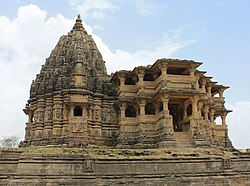](/wiki/File:Navlakha_arial_view_02_(cropped).jpg)
[Navlakha Temple, Ghumli](/wiki/Navlakha_Temple,_Ghumli "Navlakha Temple, Ghumli"), [Gujarat](/wiki/Gujarat "Gujarat"), 12th century
##### Māru-Gurjara architecture
[[edit](/w/index.php?title=Hindu_temple_architecture&action=edit§ion=20 "Edit section: Māru-Gurjara architecture")]
[Māru-Gurjara architecture](/wiki/M%C4%81ru-Gurjara_architecture "Māru-Gurjara architecture"), or Solaṅkī style,[[Republic of India 1991 (2)]](#cite_note-101) is a style of north Indian temple architecture that originated in [Gujarat](/wiki/Gujarat "Gujarat") and [Rajasthan](/wiki/Rajasthan "Rajasthan") from the 11th to 13th centuries, under the [Chaulukya dynasty](/wiki/Chaulukya_dynasty "Chaulukya dynasty") (or Solaṅkī dynasty).[[100]](#cite_note-102) Although originating as a regional style in Hindu temple architecture, it became especially popular in [Jain temples](/wiki/Jain_temple "Jain temple") and, mainly under [Jain](/wiki/Jain "Jain") patronage, later spread across India and to [diaspora](/wiki/Diaspora "Diaspora") communities around the world.[[101]](#cite_note-Hegewald-103)
On the exteriors, the style is distinguished from other north Indian temple styles of the period in "that the external walls of the temples have been structured by increasing numbers of projections and recesses, accommodating sharply carved statues in niches. These are normally positioned in superimposed registers, above the lower bands of moldings. The latter display continuous lines of horse riders, elephants, and [kīrttimukhas](/wiki/K%C4%ABrttimukha "Kīrttimukha"). Hardly any segment of the surface is left unadorned." The main [shikhara](/wiki/Shikhara "Shikhara") tower usually has many *[urushringa](/wiki/Urushringa "Urushringa")* subsidiary spirelets on it, and two smaller side-entrances with porches are common in larger temples.[[101]](#cite_note-Hegewald-103)
[](/wiki/File:BAPS_Houston_Aarti.jpg)
Devotions in the [Swaminarayan](/wiki/Swaminarayan "Swaminarayan") [temple in Houston, Texas](/wiki/BAPS_Shri_Swaminarayan_Mandir_Houston "BAPS Shri Swaminarayan Mandir Houston") (2004)
Interiors are if anything even more lavishly decorated, with elaborate carving on most surfaces. In particular, Jain temples often have small low domes carved on the inside with a highly intricate rosette design. Another distinctive feature is "flying" arch-like elements between pillars, touching the horizontal beam above in the centre, and elaborately carved. These have no structural function, and are purely decorative. The style developed large pillared halls, many open at the sides, with Jain temples often having one closed and two pillared halls in sequence on the main axis leading to the shrine.[[102]](#cite_note-104)
The style mostly fell from use in Hindu temples in its original regions by the 13th century, especially as the area had fallen to the Muslim [Delhi Sultanate](/wiki/Delhi_Sultanate "Delhi Sultanate") by 1298. But, unusually for an Indian temple style, it continued to be used by Jains there and elsewhere, with a notable "revival" in the 15th century.[[103]](#cite_note-105) Since then it has continued in use in Jain and some Hindu temples, and from the late 20th century has spread to temples built outside India by both the Jain diaspora and Hindus. Some buildings mix Māru-Gurjara elements with those of local temple styles and modern international ones. Generally, where there is elaborate carving, often still done by craftsmen from Gujarat or Rajasthan, this has more ornamental and decorative work than small figures. In particular the style is used in India and abroad by the [Swaminarayan](/wiki/Swaminarayan "Swaminarayan") sect. Sometimes the Māru-Gurjara influence is limited to the "flying arches" and mandapa ceiling rosettes, and a preference for white marble.[[101]](#cite_note-Hegewald-103)
This style is one of the oldest styles of temples on the Asian continent and derives its shape from Himalayan fir trees. The ground floor is typically the residence of the deity, either Hindu or Buddhist, while the upper floors are used as storage for religious items. There is *gajura* at the top which is the combination of a lotus base, an upside-down vase, a triangle and a kalasha. The pagoda style flourished in Nepal from the beginning of the 13th century. The temples of Pashupatinath, Changunarayan, Chandeshwori and Banepa are excellent examples of ancient architecture in the pagoda style. The Malla period produced various pagoda-style temples and palaces such as Nayatapola, Dattatraya of Bhaktapur, Kasthamandap of Kathmandu, Taleju Temple, Vajrabarahi, Vajrayogini.[[104]](#cite_note-106)
### Southeast Asia as part of Greater India
[[edit](/w/index.php?title=Hindu_temple_architecture&action=edit§ion=23 "Edit section: Southeast Asia as part of Greater India")]
Architecture of the [southeast nations was inspired](/wiki/History_of_Indian_influence_on_Southeast_Asia "History of Indian influence on Southeast Asia") by the Indian temple architecture,[[86]](#cite_note-Brit-88)[[87]](#cite_note-Unesco-89) as those were [Indianised](/wiki/Indianization_of_Southeast_Asia "Indianization of Southeast Asia") as part of the [Greater India](/wiki/Greater_India "Greater India").
#### Champa architecture
[[edit](/w/index.php?title=Hindu_temple_architecture&action=edit§ion=24 "Edit section: Champa architecture")]
[](/wiki/File:Th%C3%A1p_Po_Klaung_Garai,_Phan_Rang,_Ninh_Thu%E1%BA%ADn.JPG)
The profile of the 13th-century [Po Klong Garai Temple](/wiki/Po_Klong_Garai_Temple "Po Klong Garai Temple") near [Phan Rang](/wiki/Phan_Rang "Phan Rang") includes all the buildings typical of a Cham temple. From left to right one can see the *gopura*, the saddle-shaped *kosagrha*, and *mandapa* attached to the *kalan* tower.
Between the 6th and the 16th century, the Kingdom of [Champa](/wiki/Champa "Champa") flourished in present-day central and southern [Vietnam](/wiki/Vietnam "Vietnam"). Unlike the Javanese that mostly used volcanic [andesite](/wiki/Andesite "Andesite") stone for their temples, and [Khmer](/wiki/Khmer_people "Khmer people") of [Angkor](/wiki/Angkor "Angkor") which mostly employed grey [sandstones](/wiki/Sandstone "Sandstone") to construct their religious buildings, the [Cham](/wiki/Cham_people "Cham people") built their temples from reddish [bricks](/wiki/Brick "Brick"). The most important remaining sites of Cham bricks temple architecture include [Mỹ Sơn](/wiki/M%E1%BB%B9_S%C6%A1n "Mỹ Sơn") near [Da Nang](/wiki/Da_Nang "Da Nang"), [Po Nagar](/wiki/Po_Nagar "Po Nagar") near [Nha Trang](/wiki/Nha_Trang "Nha Trang"), and [Po Klong Garai](/wiki/Po_Klong_Garai "Po Klong Garai") near Phan Rang.[*[citation needed](/wiki/Wikipedia:Citation_needed "Wikipedia:Citation needed")*]
Typically, a Cham temple complex consisted of several different kinds of buildings.[[105]](#cite_note-107) They are *kalan*, a brick sanctuary, typically in the form of a tower with *garbahgriha* used to host the murti of deity. A *mandapa* is an entry hallway connected with a sanctuary. A *kosagrha* or "fire-house" is a temple construction typically with a saddle-shaped roof, used to house the valuables belonging to the deity or to cook for the deity. The *gopura* was a gate-tower leading into a walled temple complex. These building types are typical for Hindu temples in general; the classification is valid not only for the architecture of Champa, but also for other architectural traditions of [Greater India](/wiki/Greater_India "Greater India").[*[citation needed](/wiki/Wikipedia:Citation_needed "Wikipedia:Citation needed")*]
#### Indonesian architecture
[[edit](/w/index.php?title=Hindu_temple_architecture&action=edit§ion=25 "Edit section: Indonesian architecture")]
[Prambanan](/wiki/Prambanan "Prambanan")
temple (Shivagrha) of Central Java, an example of the 9th century Indonesian Javanese Hindu temple architecture with mandala layout and prasad tower crowned with stylised ratna-vajra.
Temples are called *[candi](/wiki/Candi_of_Indonesia "Candi of Indonesia")* (pronounced [[ˈtʃandi]](/wiki/Help:IPA/Malay "Help:IPA/Malay")) in [Indonesia](/wiki/Indonesia "Indonesia"), whether it is Buddhist or Hindu. A candi refers to a structure based on the Indian type of single-celled shrine, with a pyramidal tower above it ([Meru tower](/wiki/Meru_tower "Meru tower") in [Bali](/wiki/Bali "Bali")), and a portico for entrance,[[106]](#cite_note-ReferenceA-108) mostly built between the 7th to 15th centuries.[[106]](#cite_note-ReferenceA-108)[[107]](#cite_note-109) In Hindu [Balinese architecture](/wiki/Balinese_architecture "Balinese architecture"), a *candi* shrine can be found within a *[pura](/wiki/Balinese_temple "Balinese temple")* compound. The best example of Indonesian Javanese Hindu temple architecture is the 9th century [Prambanan](/wiki/Prambanan "Prambanan") (Shivagrha) temple compound, located in Central Java, near [Yogyakarta](/wiki/Yogyakarta "Yogyakarta"). This largest Hindu temple in Indonesia has three main prasad towers, dedicated to [Trimurti](/wiki/Trimurti "Trimurti") gods. Shiva temple, the largest main temple is towering to 47 metre-high (154 ft).
The term "candi" itself is believed was derived from *[Candika](/wiki/Chandi "Chandi")*, one of the manifestations of the goddess [Durga](/wiki/Durga "Durga") as the goddess of death.[[108]](#cite_note-110)
The *candi* architecture follows the typical Hindu architecture traditions based on [Vastu Shastra](/wiki/Vastu_Shastra "Vastu Shastra"). The temple layout, especially in central Java period, incorporated [mandala](/wiki/Mandala "Mandala") temple plan arrangements and also the typical high towering spires of Hindu temples. The candi was designed to mimic [Meru](/wiki/Mount_Meru_(mythology) "Mount Meru (mythology)"), the holy mountain the abode of gods. The whole temple is a model of Hindu universe according to [Hindu cosmology](/wiki/Hindu_cosmology "Hindu cosmology") and the layers of [Loka](/wiki/Loka "Loka").[[109]](#cite_note-SEDYAWATIp4-111)
The *candi* structure and layout recognise the hierarchy of the zones, spanned from the less holy to the holiest realms. The Indic tradition of Hindu-Buddhist architecture recognise the concept of arranging elements in three parts or three elements. Subsequently, the design, plan and layout of the temple follows the rule of space allocation within three elements; commonly identified as foot (base), body (centre), and head (roof). They are [Bhurloka](/wiki/Bhuloka "Bhuloka") represented by the outer courtyard and the foot (base) part of each temples, [Bhuvarloka](/wiki/Bhuvarloka "Bhuvarloka") represented by the middle courtyard and the body of each temples, and [Svarloka](/wiki/Svarloka "Svarloka") which symbolised by the roof of Hindu structure usually crowned with *[ratna](/wiki/Gemstone "Gemstone")* ([sanskrit](/wiki/Sanskrit "Sanskrit"): jewel) or [vajra](/wiki/Vajra "Vajra").[*[citation needed](/wiki/Wikipedia:Citation_needed "Wikipedia:Citation needed")*]
A diagram map of
[Angkor Wat](/wiki/Angkor_Wat "Angkor Wat")
reveal the concentric square galleries. On the right is an aerial view of the central structure of Angkor Wat, in front of it lies the cruciform terrace.
Before the 14th century, the [Khmer Empire](/wiki/Khmer_Empire "Khmer Empire") flourished in present-day [Cambodia](/wiki/Cambodia "Cambodia") with its influence extended to most of mainland Southeast Asia. Its great capital, [Angkor](/wiki/Angkor "Angkor") ([Khmer](/wiki/Khmer_language "Khmer language"): អង្គរ, "Capital City", derived from Sanskrit "nagara"), contains some of the most important and the most magnificent example of Khmer temple architecture. The classic style of Angkorian temple is demonstrated by the 12th century [Angkor Wat](/wiki/Angkor_Wat "Angkor Wat"). Angkorian builders mainly used [sandstone](/wiki/Sandstone "Sandstone") and [laterite](/wiki/Laterite "Laterite") as temple building materials.
The main superstructure of typical Khmer temple is a towering *prasat* called *[prang](/wiki/Prang_(architecture) "Prang (architecture)")* which houses the *garbhagriha* inner chamber, where the *murti* of Vishnu or Shiva, or a *lingam* resides. Khmer temples were typically enclosed by a concentric series of walls, with the central sanctuary in the middle; this arrangement represented the mountain ranges surrounding [Mount Meru](/wiki/Mount_Meru "Mount Meru"), the mythical home of the gods. Enclosures are the spaces between these walls, and between the innermost wall and the temple itself. The walls defining the enclosures of Khmer temples are frequently lined by galleries, while passage through the walls is by way of gopuras located at the cardinal points. The main entrance usually adorned with elevated causeway with cruciform terrace.[[110]](#cite_note-112)
The Hindu texts on temple architecture have an extensive terminology. Most terms have several different names in the various Indian languages used in different regions of India, as well as the [Sanscrit](/wiki/Sanscrit "Sanscrit") names used in ancient texts. A few of the more common terms are tabulated below, mostly in their Sanscrit/Hindi forms:[[111]](#cite_note-carthage-113)
| Term | Explanation | Synonyms or Similar | Illustrative Hindu text mention / design rules | Reference | Image |
| --- | --- | --- | --- | --- | --- |
| [Adhisthana](/wiki/Jagati_(temple) "Jagati (temple)") | [stylobate](/wiki/Stylobate "Stylobate"), [plinth](/wiki/Plinth "Plinth"), base typically with mouldings on the side, on which a temple building or pillar stands | Athavaksham, Pista, Pitha | *Manasara* XIV, *Kamikagama* 35, *Suprabhedagama* 31 | | |
| [Amalaka](/wiki/Amalaka "Amalaka") | a crowning ornament on the top of shikara, shape of an Indian *[amalok](/wiki/Phyllanthus_emblica "Phyllanthus emblica")* fruit that looks like a [cogged](/wiki/Gear "Gear") wheel. The amalaka supports the *kalasha*. | | *Mayamata śilpaśāstra* | | |
| [Antarala](/wiki/Antarala "Antarala") | lit. interior space of any building; in temples, it is the intermediate space (vestibule, antechamber) between the sanctum and space where pilgrims gather | Sukhanasi | *Manasara* XV, XXIII; *Kamikagama* XXXV | | |
| [Ardhamandapa](/wiki/Ardhamandapa "Ardhamandapa") | half hall at each entrance, usually the reception area that connects to the mandapa | | *Manasara* XIV, *Kamikagama* 35, *Suprabhedagama* 31 | | |
| Ayatana | assembly hall, grounds inside a temple or monastery compound | | *Agni Purana* XLIII, *Matsya Purana* CCLXX, *Chandogya Upanishad* 6.8.2 | | |
| Bhadra | a projection often aligned to one of the cardinal directions; typically of central part of walls; decoration or a projected porch for pilgrims; also may be a tower storey projection | | *Manasara* XXX-XXXIV | | |
| [Dvarapala](/wiki/Dvarapala "Dvarapala") | a gate guardian often portrayed as a warrior or fearsome giant | | | | |
| [Gana](/wiki/Gana "Gana") | a mythical dwarf or goblin usually with a protruded belly and with humorous expression | | | | |
| [Garbhagriha](/wiki/Garbhagriha "Garbhagriha") | The womb-house, adytum, [sanctum sanctorum](/wiki/Sanctum_sanctorum "Sanctum sanctorum"); it is the loci of the temple and the *[darshana](/wiki/Darshana "Darshana")*, the spiritual space that Hindus circumambulate clockwise about. This is where the main *[murti](/wiki/Murti "Murti")* image is placed. Usually the space is very plain, with no distractions from the murti, which is rich in symbolism. A large temple may have many shrines, each with a garbhagriya. | Garbha-griya, Garbha-geha, Sibika, Garbha, Mula-sthana | *Brihat Samhita* LXI | [[111]](#cite_note-carthage-113) | |
| [Gavaksha](/wiki/Gavaksha "Gavaksha") | one of the arch motifs; it is horseshoe-shaped, found with windows or for decorating spires, pillars and other elements | Gavaksa, kudu | | | |
| [Gopuram](/wiki/Gopuram "Gopuram") | a gateway at entrance or one that connects two sacred spaces of the temple; becomes very large in South Indian temples, which may have several; it has roots in ancient Indian monasteries and the Vedic word *gomatipur*; | Gopura, Dvara attalaka | *Agni Purana* XLII, *Manasara* XI, XXXIII verses 1–601, LVIII | | |
| Hara | neck ornament such as necklace | | | | |
| [Jala](/wiki/Jali "Jali") | a trellis, stone grille, net, first seen in 6th-century temples | Jali, Indra koshtha | | | |
| [Jagati](/wiki/Jagati_(temple) "Jagati (temple)") | any moulded base or pedestal for the temple or a statue that extends out, part of platform that forms a terrace to stand on or circumambulate around on, while reading the reliefs and friezes | Jagata, Pithika, Jagati-pitha, Kati, Vasudha | *Samarangana-sutradhara* LXVIII, *Agni Purana* XLII, *Suprabhedagama* 31.19 | | |
| [Kalasha](/wiki/Kalasha "Kalasha") | the pinnacle element of a temple, a vase finial, cupola or pitcher | [Kalasam](/wiki/Kalasam "Kalasam"), Stupi, Kumuda | *Agni Purana* CIV, *Kamikagama* 55 | | |
| Kunda | [temple tank](/wiki/Temple_tank "Temple tank"), [stepwell](/wiki/Stepwell "Stepwell"), pool, usually with steps, public utility for taking a dip; often connected to a nearby river or mountain stream | Pushkarani, Sara, Sagar, Tadaga, Udapana, Var, Vapi | *Garuda Purana* XLVI, *Mahanirvana tantra* XIII | | |
| Lata | liana, creeper-style plant, vine, one type of scroll work; also found on shikhara | | | | |
| [Makara](/wiki/Makara_(Hindu_mythology) "Makara (Hindu mythology)") | a mythical fusion sea creature with fish-crocodile like face, trunk or snout, legs sometimes with lion claws and a tail; vahana of [Varuna](/wiki/Varuna "Varuna") | | *Suprabhedagama* 31.68-72 | | |
| [Mandapa](/wiki/Mandapa "Mandapa") | pillared hall or pavilion, with pillars usually carved; a mandapa is typically square, rectangle, octagonal or circular; it may have walls with perforated stone windows, it may just be open on some or all sides. Large temples may have many interconnected mandapas. It is a gathering place, a place for pilgrims to rest (choultry), a part of the circumambulation space, or to wait during prayers or [Sanskara (rite of passage)](/wiki/Sanskara_(rite_of_passage) "Sanskara (rite of passage)") rituals. A mandapa may have a tower (shikhara) of its own, but it is lower than that above the sanctum. | Mandapam, Mantapa, Jagamohan | *Manasara* XXXII-XXXIV, *Kamikagama* 50, *Brihat samhita*, *Vishnu Purana* 6.124-136 | | |
| Mulaprasada | main shrine in a temple complex | | | | |
| Nisha | niche on temple walls or in pillars for sculptures or stele | | | | |
| Nyasa | the art of arranging images and friezes to create a narrative or composition, in some texts it refers to relative placement of images within a panel to summarise a Hindu legend or fable; also a form a ritual. | | *Vastusutra Upanishad* VI | [[131]](#cite_note-133) | |
| [Prakara](/wiki/Prakara "Prakara") | wall that separates an inner zone of temple ground from an outer zone; typically concentric, defensive and fortified, a feature added after the wars and plunders starting in the 14th-century | | | [[133]](#cite_note-Starza1993p20-135) | |
| [Prastara](/wiki/Prastara "Prastara") | entablature, horizontal superstructure of bands and mouldings above column capitals, sometimes functions as a parapet of a storey | Chaiva, gopanam, kapotam, mancham | *Manasara* XVI; *Kamikagama* LIV | | |
| [Ratha](/wiki/Ratha_(architecture) "Ratha (architecture)") | a facet or vertical offset projection on the plan of the sanctum and [shikhara](/wiki/Shikhara "Shikhara") above, or other structure. It is generally carried up from the bottom of the temple to the superstructure. A [ratha](/wiki/Ratha "Ratha"), meaning cart, is also the temple chariot used for processing the murti at festivals, and a "ratha temple" is one designed to resemble a cart, with wheels on the sides, and often horses. The most famous example is the [Sun Temple, Konarak](/wiki/Sun_Temple,_Konarak "Sun Temple, Konarak"). | | | [[137]](#cite_note-139) | |
| Sala | Round barrel-roofed, wagon-roofed pavilion; rooted in the thatched roofed stall for people or cattle tradition, then other materials of construction; any mansion or griha; a pilgrim services building with mandapas or pillared veranda or both inside the temple complex, Hindu texts describe multi-storey Sala; in south, sala are structures used as a decorative motif, or an actual roof, as at the top of gopurams; rooted in ancient thatched roof styles. | Chala | *Manasara* XXXV verses 1-404 | [[138]](#cite_note-140) | |
| [Shikhara](/wiki/Shikhara "Shikhara")/[Vimana](/wiki/Vimana_(architectural_feature) "Vimana (architectural feature)") | In North India, the tower above the sanctum (entire spire above mulaprasada); in South India, that top part of tower that is above the vimana | Shikha, Shikhanta, Shikhamani, [Deul](/wiki/Deul "Deul") in East India, Garbhaka, Garbhamandira | *Brihat Samhita* LVI | | |
| [Stambha](/wiki/Stambha "Stambha") | A pillar; it can be a load bearing element or an independent standing element with *diya* (lamps) and Hindu icons below, around and / or on top; the designs vary significantly by region, in Kerala Hindu temples they are at the entrance; on festive occasions the wick lamps are loaded with oil and lit up. | Kambha, Dhvajastambha, Kodimaram | *Manasara* XV, *Kaśyapa śilpa śāstra* IX | | |
| [Sukanasa](/wiki/Sukanasa "Sukanasa") | an external ornamented feature over the entrance to the [garbhagriha](/wiki/Garbhagriha "Garbhagriha") or inner shrine. It sits on the face of the [shikhara](/wiki/Shikhara "Shikhara") tower (in South India, the [vimana](/wiki/Vimana_(architectural_feature) "Vimana (architectural feature)")) as a sort of [antefix](/wiki/Antefix "Antefix"). Can refer to the [antarala](/wiki/Antarala "Antarala") below as well. | sukanasa-sika | *Agni Purana* XLII | | |
| [Tala](/wiki/Tala_(Hindu_architecture) "Tala (Hindu architecture)") | tier or storey of a shikhara, vimana or gopuram | | | | |
| [Torana](/wiki/Torana "Torana") | any arch or canopy motif, ornament or architectural member in temples and buildings; it also refers to an arched gateway | Numerous terms, e.g. Gavaksha (from 'cow eye'-shaped) | *Garuda Purana* XLVII, *Manasara* XLVI verses 1-77 | | |
| [Urushringa](/wiki/Urushringa "Urushringa") | subsidiary turret-like shikharas on the side of the main shikhara; the primary turret is called *shringa* | | *Brihat Samhita* LVI, *Agni Purana* CIV | [[146]](#cite_note-148) | |
* Single storey gopura (Dravidian architecture)
* Two storey gopura (Dravidian architecture)
* Pillar elements (shared by Nagara and Dravidian)
* Athisthana architectural elements of a Hindu temple
* Entablature elements
* A vimana with mandapam elements (Dravidian architecture)
1. **[^](#cite_ref-43)** Richard Salomon dates the earliest Cambodian Sanskrit inscriptions to the 5th century.[[42]](#cite_note-Salomon1998p155-42)
2. **[^](#cite_ref-85)** In rare cases, such as the Brihadishvara temple at Gangaikondacholapuram, the centre is outside the temple.
1. **[^](#cite_ref-1)** These are the usual terms, but there are many variants or different ones in the many Indian languages, ancient and modern.
2. ^ [***a***](#cite_ref-stellakvolume1_2-0) [***b***](#cite_ref-stellakvolume1_2-1) [***c***](#cite_ref-stellakvolume1_2-2) [***d***](#cite_ref-stellakvolume1_2-3) [***e***](#cite_ref-stellakvolume1_2-4) [***f***](#cite_ref-stellakvolume1_2-5) [***g***](#cite_ref-stellakvolume1_2-6) [***h***](#cite_ref-stellakvolume1_2-7) [***i***](#cite_ref-stellakvolume1_2-8) [***j***](#cite_ref-stellakvolume1_2-9) [***k***](#cite_ref-stellakvolume1_2-10) [***l***](#cite_ref-stellakvolume1_2-11) [***m***](#cite_ref-stellakvolume1_2-12) [***n***](#cite_ref-stellakvolume1_2-13) [Stella Kramrisch](/wiki/Stella_Kramrisch "Stella Kramrisch"), The Hindu Temple, Vol 1, Motilal Banarsidass, [ISBN](/wiki/ISBN_(identifier) "ISBN (identifier)") [978-81-208-0222-3](/wiki/Special:BookSources/978-81-208-0222-3 "Special:BookSources/978-81-208-0222-3")
3. **[^](#cite_ref-4)** Jack Hebner (2010), Architecture of the Vastu Sastra - According to Sacred Science, in Science of the Sacred (Editor: David Osborn), [ISBN](/wiki/ISBN_(identifier) "ISBN (identifier)") [978-0557277247](/wiki/Special:BookSources/978-0557277247 "Special:BookSources/978-0557277247"), pp 85-92; N Lahiri (1996), Archaeological landscapes and textual images: a study of the sacred geography of late medieval Ballabgarh, World Archaeology, 28(2), pp 244-264
4. **[^](#cite_ref-bbdutt_5-0)** BB Dutt (1925), *[Town planning in Ancient India](https://books.google.com/books?id=J3jEJFNxdy4C)* at [Google Books](/wiki/Google_Books "Google Books"), [ISBN](/wiki/ISBN_(identifier) "ISBN (identifier)") [978-81-8205-487-5](/wiki/Special:BookSources/978-81-8205-487-5 "Special:BookSources/978-81-8205-487-5")
5. ^ [***a***](#cite_ref-mmgeometry_6-0) [***b***](#cite_ref-mmgeometry_6-1) [***c***](#cite_ref-mmgeometry_6-2) [***d***](#cite_ref-mmgeometry_6-3) [***e***](#cite_ref-mmgeometry_6-4) [***f***](#cite_ref-mmgeometry_6-5) Meister, Michael (1983). "Geometry and Measure in Indian Temple Plans: Rectangular Temples". *Artibus Asiae*. **44** (4): 266–296. [doi](/wiki/Doi_(identifier) "Doi (identifier)"):[10.2307/3249613](https://doi.org/10.2307%2F3249613). [JSTOR](/wiki/JSTOR_(identifier) "JSTOR (identifier)") [3249613](https://www.jstor.org/stable/3249613).
6. **[^](#cite_ref-7)** Harle, James Coffin (1994). *The art and architecture of the Indian subcontinent* (2nd ed.). New Haven London: Yale University Press. p. 201. [ISBN](/wiki/ISBN_(identifier) "ISBN (identifier)") [978-0-300-06217-5](/wiki/Special:BookSources/978-0-300-06217-5 "Special:BookSources/978-0-300-06217-5").
7. **[^](#cite_ref-8)** Michell, George (1990). *The Penguin guide to the monument of India*. London: Penguin book. pp. 228–229. [ISBN](/wiki/ISBN_(identifier) "ISBN (identifier)") [978-0-14-008144-2](/wiki/Special:BookSources/978-0-14-008144-2 "Special:BookSources/978-0-14-008144-2").
8. **[^](#cite_ref-9)** [*Approaches to Iconology*](https://books.google.com/books?id=UesUAAAAIAAJ&pg=PA41). Brill Archive. 1985. p. 41. [ISBN](/wiki/ISBN_(identifier) "ISBN (identifier)") [978-90-04-07772-0](/wiki/Special:BookSources/978-90-04-07772-0 "Special:BookSources/978-90-04-07772-0").
9. **[^](#cite_ref-10)** Ghosh, A. (1967). [*Indian Archaeology 1963-64, A Review*](https://zenodo.org/record/3416858). ASI. p. 17. [doi](/wiki/Doi_(identifier) "Doi (identifier)"):[10.5281/zenodo.3416858](https://doi.org/10.5281%2Fzenodo.3416858).
10. **[^](#cite_ref-11)** Archaeological Survey Of India (1965). [*Indian Archaeology -- A Review 1964-65*](https://zenodo.org/record/1442629). pp. 19–20, BSN-3. [doi](/wiki/Doi_(identifier) "Doi (identifier)"):[10.5281/zenodo.1442629](https://doi.org/10.5281%2Fzenodo.1442629).
11. **[^](#cite_ref-12)** Shaw, Julia (31 August 2013). [*Buddhist Landscapes in Central India: Sanchi Hill and Archaeologies of Religious and Social Change, C. Third Century BC to Fifth Century AD*](https://books.google.com/books?id=jzkyBgAAQBAJ&pg=PA40). Left Coast Press. p. 40. [ISBN](/wiki/ISBN_(identifier) "ISBN (identifier)") [978-1-61132-344-3](/wiki/Special:BookSources/978-1-61132-344-3 "Special:BookSources/978-1-61132-344-3").
12. **[^](#cite_ref-13)** Mishra, Susan Verma; Ray, Himanshu Prabha (2016). [*The Archaeology of Sacred Spaces: The temple in western India, 2nd century BCE–8th century CE*](https://books.google.com/books?id=CtDLDAAAQBAJ&pg=PA5). Routledge. p. 5. [ISBN](/wiki/ISBN_(identifier) "ISBN (identifier)") [978-1-317-19374-6](/wiki/Special:BookSources/978-1-317-19374-6 "Special:BookSources/978-1-317-19374-6").
13. **[^](#cite_ref-14)** Ray, Himanshu Prabha (2004). ["The Apsidal Shrine in Early Hinduism: Origins, Cultic Affiliation, Patronage"](https://www.jstor.org/stable/4128336). *World Archaeology*. **36** (3): 348. [doi](/wiki/Doi_(identifier) "Doi (identifier)"):[10.1080/0043824042000282786](https://doi.org/10.1080%2F0043824042000282786). [ISSN](/wiki/ISSN_(identifier) "ISSN (identifier)") [0043-8243](https://search.worldcat.org/issn/0043-8243). [JSTOR](/wiki/JSTOR_(identifier) "JSTOR (identifier)") [4128336](https://www.jstor.org/stable/4128336). [S2CID](/wiki/S2CID_(identifier) "S2CID (identifier)") [161072766](https://api.semanticscholar.org/CorpusID:161072766).
14. **[^](#cite_ref-15)** Shaw, Julia (31 August 2013). [*Buddhist Landscapes in Central India: Sanchi Hill and Archaeologies of Religious and Social Change, C. Third Century BC to Fifth Century AD*](https://books.google.com/books?id=jzkyBgAAQBAJ&pg=PA176). Left Coast Press. pp. 176–177. [ISBN](/wiki/ISBN_(identifier) "ISBN (identifier)") [978-1-61132-344-3](/wiki/Special:BookSources/978-1-61132-344-3 "Special:BookSources/978-1-61132-344-3").
15. **[^](#cite_ref-16)** N. Ramya (1 August 2010). ["New finds of old temples enthuse archaeologists"](https://timesofindia.indiatimes.com/city/chennai/New-finds-of-old-temples-enthuse-archaeologists/articleshow/6242174.cms). *[The Times of India](/wiki/The_Times_of_India "The Times of India")*. [Archived](https://web.archive.org/web/20120915014729/http://articles.timesofindia.indiatimes.com/2010-08-01/chennai/28281794_1_inscription-shore-temple-oldest-temples) from the original on 15 September 2012.
16. **[^](#cite_ref-17)** Kumar, Ashish (2013). ["Heliodorous Pillar of Besnagar- Past and Present (pp. 13-19)"](https://www.academia.edu/3360811). *Heritage and Us*. Year 2 (1): 15–16.
17. ^ [***a***](#cite_ref-MDK92_18-0) [***b***](#cite_ref-MDK92_18-1) [***c***](#cite_ref-MDK92_18-2) [***d***](#cite_ref-MDK92_18-3) Khare, M. D. (1975). ["THE HELIODORUS PILLAR—A FRESH APPRAISAL, BY JOHN IRWIN ( AARP—ART AND ARCHAEOLOGY RESEARCH PAPERS—DECEMBER 1974 ) A REJOINDER"](https://www.jstor.org/stable/44138838). *Proceedings of the Indian History Congress*. **36**: 92–93. [ISSN](/wiki/ISSN_(identifier) "ISSN (identifier)") [2249-1937](https://search.worldcat.org/issn/2249-1937). [JSTOR](/wiki/JSTOR_(identifier) "JSTOR (identifier)") [44138838](https://www.jstor.org/stable/44138838).
18. **[^](#cite_ref-19)** A., Gosh. *Indian Archaeology: A Review 1963-64*. Calcutta: Archaeological survey of India. p. 17.
19. **[^](#cite_ref-20)** Shaw, Julia (31 August 2013). [*Buddhist Landscapes in Central India: Sanchi Hill and Archaeologies of Religious and Social Change, C. Third Century BC to Fifth Century AD*](https://books.google.com/books?id=jzkyBgAAQBAJ&pg=PA264). Left Coast Press. p. 264, note 14; 265, note 10. [ISBN](/wiki/ISBN_(identifier) "ISBN (identifier)") [978-1-61132-344-3](/wiki/Special:BookSources/978-1-61132-344-3 "Special:BookSources/978-1-61132-344-3").
20. **[^](#cite_ref-21)** Harle, James C. (January 1994). [*The Art and Architecture of the Indian Subcontinent*](https://books.google.com/books?id=LwcBVvdqyBkC&pg=PA116). Yale University Press. p. 116. [ISBN](/wiki/ISBN_(identifier) "ISBN (identifier)") [978-0-300-06217-5](/wiki/Special:BookSources/978-0-300-06217-5 "Special:BookSources/978-0-300-06217-5").
21. **[^](#cite_ref-22)** Harle (1994), 87-100; Michell (1988), 18
22. ^ [***a***](#cite_ref-meister254_23-0) [***b***](#cite_ref-meister254_23-1) Meister, Michael W. (1988–1989). "Prāsāda as Palace: Kūṭina Origins of the Nāgara Temple". *Artibus Asiae*. **49** (3–4): 254–256. [doi](/wiki/Doi_(identifier) "Doi (identifier)"):[10.2307/3250039](https://doi.org/10.2307%2F3250039). [JSTOR](/wiki/JSTOR_(identifier) "JSTOR (identifier)") [3250039](https://www.jstor.org/stable/3250039).
23. ^ [***a***](#cite_ref-meister370_24-0) [***b***](#cite_ref-meister370_24-1) Michael Meister (1987), Hindu Temple, in *The Encyclopedia of Religion*, editor: Mircea Eliade, Volume 14, Macmillan, [ISBN](/wiki/ISBN_(identifier) "ISBN (identifier)") [0-02-909850-5](/wiki/Special:BookSources/0-02-909850-5 "Special:BookSources/0-02-909850-5"), page 370
24. **[^](#cite_ref-25)** Michell (1990), 192
25. **[^](#cite_ref-26)** Michell (1990), 157; Michell (1988), 96
26. ^ [***a***](#cite_ref-meister280_27-0) [***b***](#cite_ref-meister280_27-1) Meister, Michael W. (1988–1989). "Prāsāda as Palace: Kūṭina Origins of the Nāgara Temple". *Artibus Asiae*. **49** (3–4): 254–280. [doi](/wiki/Doi_(identifier) "Doi (identifier)"):[10.2307/3250039](https://doi.org/10.2307%2F3250039). [JSTOR](/wiki/JSTOR_(identifier) "JSTOR (identifier)") [3250039](https://www.jstor.org/stable/3250039).
27. **[^](#cite_ref-28)** Harle, 136-138; Michell (1988), 90, 96-98
28. **[^](#cite_ref-29)** Michell (1990), 349
29. **[^](#cite_ref-30)** Michael W. Meister and M.A. Dhaky (1983), *South India: Lower Dravidadesa*, Encyclopaedia of Indian Temple Architecture, Vol. I, Part I, Princeton University Press, [ISBN](/wiki/ISBN_(identifier) "ISBN (identifier)") [978-0691784021](/wiki/Special:BookSources/978-0691784021 "Special:BookSources/978-0691784021"), pages 30-53
30. ^ [***a***](#cite_ref-michellharle335_31-0) [***b***](#cite_ref-michellharle335_31-1) [***c***](#cite_ref-michellharle335_31-2) Michell (1988), 18, 50-54, 89, 149-155; Harle (1994), 335
31. **[^](#cite_ref-32)** Michell, 149
32. **[^](#cite_ref-33)** Harle, 254
33. **[^](#cite_ref-34)** Harle, 256-261
34. **[^](#cite_ref-35)** Lisa Nadine Owen, Beyond Buddhist and Brahmanical Activity: The Place of the Jain Rock-Cut Excavations at Ellora, PhD thesis 2006, University of Texas at Austin p. 255
35. **[^](#cite_ref-golden_36-0)** An important period in the development of Indian art (Kamath 2001, p115)
36. **[^](#cite_ref-golden1_37-0)** Arthikaje. ["History of Karnataka – Chalukyas of Kalyani"](https://web.archive.org/web/20061104095148/http://www.ourkarnataka.com/history.htm). 1998–2000 OurKarnataka.Com, Inc. Archived from [the original](http://www.ourkarnataka.com/history.htm) on 4 November 2006. Retrieved 10 November 2006.
37. **[^](#cite_ref-gadag_38-0)** Kannikeswaran. ["Temples of Karnataka, Kalyani Chalukyan temples"](http://www.templenet.com/Karnataka/kalyani_chalukya.html).
[email protected],1996–2006. Retrieved 16 December 2006.
38. **[^](#cite_ref-FOOTNOTEGeorge_Michell19959%E2%80%9310,_Quote:_"The_era_under_consideration_opens_with_an_unprecedented_calamity_for_Southern_India:_the_invasion_of_the_region_at_the_turn_of_the_fourteenth_century_by_Malik_Kafur,_general_of_Alauddin,_Sultan_of_Delhi._Malik_Kafur's_forces_brought_to_an_abrupt_end_all_of_the_indigenous_ruling_houses_of_Southern_India,_not_one_of_which_was_able_to_withstand_the_assault_or_outlive_the_conquest._Virtually_every_city_of_importance_in_the_Kannada,_Telugu_and_Tamil_zones_succumbed_to_the_raids_of_Malik_Kafur,_forts_were_destroyed,_palaces_dismantled_and_temple_sanctuaries_wrecked_in_the_search_for_treasure._In_order_to_consolidate_the_rapidly_won_gains_of_this_pillage,_Malik_Kafur_established_himself_in_1323_at_Madurai_(Madura)_in_the_southernmost_part_of_the_Tamil_zone,_former_capital_of_the_Pandyas_who_were_dislodged_by_the_Delhi_forces._Madurai_thereupon_became_the_capital_of_the_Ma'bar_(Malabar)_province_of_the_[[Delhi_Sultanate|Delhi_empire]]."_39-0)** [George Michell 1995](#CITEREFGeorge_Michell1995), pp. 9–10, Quote: "The era under consideration opens with an unprecedented calamity for Southern India: the invasion of the region at the turn of the fourteenth century by Malik Kafur, general of Alauddin, Sultan of Delhi. Malik Kafur's forces brought to an abrupt end all of the indigenous ruling houses of Southern India, not one of which was able to withstand the assault or outlive the conquest. Virtually every city of importance in the Kannada, Telugu and Tamil zones succumbed to the raids of Malik Kafur, forts were destroyed, palaces dismantled and temple sanctuaries wrecked in the search for treasure. In order to consolidate the rapidly won gains of this pillage, Malik Kafur established himself in 1323 at Madurai (Madura) in the southernmost part of the Tamil zone, former capital of the Pandyas who were dislodged by the Delhi forces. Madurai thereupon became the capital of the Ma'bar (Malabar) province of the [Del... [truncated]
39. **[^](#cite_ref-40)** Sen, Võ Văn; Thắng, Đặng Văn (6 October 2017). ["Recognition of Oc Eo Culture Relic in Thoai Son District An Giang Province, Vietnam"](http://asrjetsjournal.org/index.php/American_Scientific_Journal/article/view/3393). *American Scientific Research Journal for Engineering, Technology, and Sciences*. **36** (1): 271–293. [ISSN](/wiki/ISSN_(identifier) "ISSN (identifier)") [2313-4402](https://search.worldcat.org/issn/2313-4402).
40. **[^](#cite_ref-Ooi2004p587_41-0)** [Ooi, Keat Gin](/wiki/Keat_Gin_Ooi "Keat Gin Ooi") (2004). [*Southeast Asia: A Historical Encyclopedia, from Angkor Wat to East Timor*](https://books.google.com/books?id=QKgraWbb7yoC&pg=PA587). ABC-CLIO. pp. 587–588. [ISBN](/wiki/ISBN_(identifier) "ISBN (identifier)") [978-1-57607-770-2](/wiki/Special:BookSources/978-1-57607-770-2 "Special:BookSources/978-1-57607-770-2").
41. **[^](#cite_ref-Salomon1998p155_42-0)** Richard Salomon (1998). [*Indian Epigraphy: A Guide to the Study of Inscriptions in Sanskrit, Prakrit, and the other Indo-Aryan Languages*](https://books.google.com/books?id=XYrG07qQDxkC). Oxford University Press. pp. 155–157. [ISBN](/wiki/ISBN_(identifier) "ISBN (identifier)") [978-0-19-535666-3](/wiki/Special:BookSources/978-0-19-535666-3 "Special:BookSources/978-0-19-535666-3").
42. **[^](#cite_ref-44)** Michell (1988), 18-19, 54, 159-182
43. **[^](#cite_ref-Bakker1990p160_45-0)** Richard Salomon (1990). ["Indian Tirthas in Southeast Asia"](https://books.google.com/books?id=McwUAAAAIAAJ). In Hans Bakker (ed.). *The History of Sacred Places in India As Reflected in Traditional Literature: Papers on Pilgrimage in South Asia*. BRILL Academic. pp. 160–176. [ISBN](/wiki/ISBN_(identifier) "ISBN (identifier)") [978-90-04-09318-8](/wiki/Special:BookSources/978-90-04-09318-8 "Special:BookSources/978-90-04-09318-8")., Quote: "In the Indianized regions of ancient southeast Asia, comprising the modern nations of Burma, Thailand, Malaysia, Cambodia, Laos, Vietnam and Indonesia (...)"
44. **[^](#cite_ref-47)** ["Prambanan - Taman Wisata Candi"](http://borobudurpark.com/en/temple/prambanan-2/). *borobudurpark.com*. Retrieved 15 December 2017.
45. **[^](#cite_ref-48)** Centre, UNESCO World Heritage. ["Angkor"](https://whc.unesco.org/en/list/668). *whc.unesco.org*. Retrieved 15 December 2017.
46. ^ [***a***](#cite_ref-susanlchap4_49-0) [***b***](#cite_ref-susanlchap4_49-1) [***c***](#cite_ref-susanlchap4_49-2) Susan Lewandowski, The Hindu Temple in South India, in Buildings and Society: Essays on the Social Development of the Built Environment, Anthony D. King (Editor), [ISBN](/wiki/ISBN_(identifier) "ISBN (identifier)") [978-0710202345](/wiki/Special:BookSources/978-0710202345 "Special:BookSources/978-0710202345"), Routledge, Chapter 4
47. **[^](#cite_ref-50)** Alain Daniélou (2001), The Hindu Temple: Deification of Eroticism, Translated from French to English by Ken Hurry, [ISBN](/wiki/ISBN_(identifier) "ISBN (identifier)") [0-89281-854-9](/wiki/Special:BookSources/0-89281-854-9 "Special:BookSources/0-89281-854-9"), pp 101-127
48. **[^](#cite_ref-51)** Samuel Parker (2010), Ritual as a Mode of Production: Ethnoarchaeology and Creative Practice in Hindu Temple Arts, South Asian Studies, 26(1), pp 31-57; Michael Rabe, Secret Yantras and Erotic Display for Hindu Temples, (Editor: David White), [ISBN](/wiki/ISBN_(identifier) "ISBN (identifier)") [978-8120817784](/wiki/Special:BookSources/978-8120817784 "Special:BookSources/978-8120817784"), Princeton University Readings in Religion (Motilal Banarsidass Publishers), Chapter 25, pp 435-446
49. **[^](#cite_ref-52)** [Stella Kramrisch](/wiki/Stella_Kramrisch "Stella Kramrisch"), The Hindu Temple, Vol 1, Motilal Banarsidass, [ISBN](/wiki/ISBN_(identifier) "ISBN (identifier)") [978-81-208-0222-3](/wiki/Special:BookSources/978-81-208-0222-3 "Special:BookSources/978-81-208-0222-3"), page 5-6
50. ^ [***a***](#cite_ref-Michell_1988,_50_53-0) [***b***](#cite_ref-Michell_1988,_50_53-1) Michell (1988), 50
51. ^ [***a***](#cite_ref-sl6869_54-0) [***b***](#cite_ref-sl6869_54-1) [***c***](#cite_ref-sl6869_54-2) [***d***](#cite_ref-sl6869_54-3) [***e***](#cite_ref-sl6869_54-4) Susan Lewandowski, The Hindu Temple in South India, in Buildings and Society: Essays on the Social Development of the Built Environment, Anthony D. King (Editor), [ISBN](/wiki/ISBN_(identifier) "ISBN (identifier)") [978-0710202345](/wiki/Special:BookSources/978-0710202345 "Special:BookSources/978-0710202345"), Routledge, pp 68-69
52. **[^](#cite_ref-55)** Stella Kramrisch (1976), The Hindu Temple Volume 1 & 2, [ISBN](/wiki/ISBN_(identifier) "ISBN (identifier)") [81-208-0223-3](/wiki/Special:BookSources/81-208-0223-3 "Special:BookSources/81-208-0223-3")
53. **[^](#cite_ref-56)** In addition to square (4) sided layout, Brhat Samhita also describes Vastu and mandala design principles based on a perfect triangle (3), hexagon (6), octagon (8) and hexadecagon (16) sided layouts, according to [Stella Kramrisch](/wiki/Stella_Kramrisch "Stella Kramrisch"). The 49 grid design is called Sthandila and of great importance in creative expressions of Hindu temples in South India, particularly in ‘‘Prakaras’’.
54. **[^](#cite_ref-57)** Meister, Michael W. (March 2006). "Mountain Temples and Temple-Mountains: Masrur". *Journal of the Society of Architectural Historians*. **65** (1): 26–49. [doi](/wiki/Doi_(identifier) "Doi (identifier)"):[10.2307/25068237](https://doi.org/10.2307%2F25068237). [JSTOR](/wiki/JSTOR_(identifier) "JSTOR (identifier)") [25068237](https://www.jstor.org/stable/25068237).
55. **[^](#cite_ref-59)** Trivedi, K. (1989). Hindu temples: models of a fractal universe. The Visual Computer, 5(4), 243-258
56. **[^](#cite_ref-60)** Susan Lewandowski, The Hindu Temple in South India, in Buildings and Society: Essays on the Social Development of the Built Environment, Anthony D. King (Editor), [ISBN](/wiki/ISBN_(identifier) "ISBN (identifier)") [978-0710202345](/wiki/Special:BookSources/978-0710202345 "Special:BookSources/978-0710202345"), Routledge, pp 71-73
57. **[^](#cite_ref-61)** Meister, Michael W. (April–June 1979). "Maṇḍala and Practice in Nāgara Architecture in North India". *Journal of the American Oriental Society*. **99** (2): 204–219. [doi](/wiki/Doi_(identifier) "Doi (identifier)"):[10.2307/602657](https://doi.org/10.2307%2F602657). [JSTOR](/wiki/JSTOR_(identifier) "JSTOR (identifier)") [602657](https://www.jstor.org/stable/602657).
58. ^ [***a***](#cite_ref-michell55b_63-0) [***b***](#cite_ref-michell55b_63-1) [***c***](#cite_ref-michell55b_63-2) [***d***](#cite_ref-michell55b_63-3) Michell (1988), 55–56 with Figure 20
59. **[^](#cite_ref-64)** Michell (1988), 55-57
60. **[^](#cite_ref-65)** Stella Kramrisch (1994), Exploring India's Sacred Art, Editor: Stella Miller, Motilal Banarsidass, [ISBN](/wiki/ISBN_(identifier) "ISBN (identifier)") [978-81-208-1208-6](/wiki/Special:BookSources/978-81-208-1208-6 "Special:BookSources/978-81-208-1208-6"), pages 60–64
61. ^ [***a***](#cite_ref-michell57_66-0) [***b***](#cite_ref-michell57_66-1) [***c***](#cite_ref-michell57_66-2) [***d***](#cite_ref-michell57_66-3) [***e***](#cite_ref-michell57_66-4) Michell (1988), 54-55, 57
62. **[^](#cite_ref-67)** Michell (1988), 57
63. **[^](#cite_ref-Dhaky1977p1_69-0)** Madhusudan A. Dhaky (1977). [*The Indian Temple Forms in Karṇāṭa Inscriptions and Architecture*](https://books.google.com/books?id=VyW32NwcMr4C). Abhinav Publications. pp. 1–19. [ISBN](/wiki/ISBN_(identifier) "ISBN (identifier)") [978-81-7017-065-5](/wiki/Special:BookSources/978-81-7017-065-5 "Special:BookSources/978-81-7017-065-5").
64. **[^](#cite_ref-70)** Tarapada Bhattacharyya (1986). [*The Canons of Indian Art: Or, a Study on Vāstuvidyā*](https://books.google.com/books?id=cGAPNQAACAAJ). Firma KLM. pp. i–v, 87–99, 201–204, 291–292. [ISBN](/wiki/ISBN_(identifier) "ISBN (identifier)") [978-0-8364-1618-3](/wiki/Special:BookSources/978-0-8364-1618-3 "Special:BookSources/978-0-8364-1618-3").
65. **[^](#cite_ref-71)** Tarapada Bhattacharyya (1986). [*The Canons of Indian Art: Or, a Study on Vāstuvidyā*](https://books.google.com/books?id=cGAPNQAACAAJ). Firma KLM. pp. 155–163. [ISBN](/wiki/ISBN_(identifier) "ISBN (identifier)") [978-0-8364-1618-3](/wiki/Special:BookSources/978-0-8364-1618-3 "Special:BookSources/978-0-8364-1618-3").
66. ^ [***a***](#cite_ref-Hardy2009p41_72-0) [***b***](#cite_ref-Hardy2009p41_72-1) Hardy, Adam (2009). ["Drāvida Temples in the Samarānganasūtradhāra"](http://orca.cf.ac.uk/13911/1/Dravida%20Temples%20in%20the%20Samarangana.pdf) (PDF). *South Asian Studies*. **25** (1): 41–62. [doi](/wiki/Doi_(identifier) "Doi (identifier)"):[10.1080/02666030.2009.9628698](https://doi.org/10.1080%2F02666030.2009.9628698). [S2CID](/wiki/S2CID_(identifier) "S2CID (identifier)") [15290721](https://api.semanticscholar.org/CorpusID:15290721).
67. **[^](#cite_ref-75)** Fergusson, James (1864). [*The Rock-cut Temples of India: Illustrated by Seventy-four Photographs Taken on the Spot by Major Gill*](https://books.google.com/books?id=mmtDAQAAMAAJ&q=dravidian+architecture+in+maharashtra). J. Murray.
68. **[^](#cite_ref-76)** Hardy, Adam (2007). [*The Temple Architecture of India*](https://books.google.com/books?id=ofUVAQAAIAAJ&q=dravidian+architecture+in+maharashtra). Wiley. [ISBN](/wiki/ISBN_(identifier) "ISBN (identifier)") [978-0-470-02827-8](/wiki/Special:BookSources/978-0-470-02827-8 "Special:BookSources/978-0-470-02827-8").
69. **[^](#cite_ref-77)** Hardy (1995), 5; Michell (1988), 88-89
70. **[^](#cite_ref-79)** Michell (1988), 155-182; Hardy (1995), 5-10
71. **[^](#cite_ref-Dhaky1977p7_80-0)** Madhusudan A. Dhaky (1977). [*The Indian Temple Forms in Karṇāṭa Inscriptions and Architecture*](https://books.google.com/books?id=VyW32NwcMr4C). Abhinav Publications. pp. 7–13. [ISBN](/wiki/ISBN_(identifier) "ISBN (identifier)") [978-81-7017-065-5](/wiki/Special:BookSources/978-81-7017-065-5 "Special:BookSources/978-81-7017-065-5").
72. **[^](#cite_ref-81)** Hardy (1995), 5-8
73. **[^](#cite_ref-Dhaky1977p14_82-0)** Madhusudan A. Dhaky (1977). [*The Indian Temple Forms in Karṇāṭa Inscriptions and Architecture*](https://books.google.com/books?id=VyW32NwcMr4C). Abhinav Publications. pp. 14–19. [ISBN](/wiki/ISBN_(identifier) "ISBN (identifier)") [978-81-7017-065-5](/wiki/Special:BookSources/978-81-7017-065-5 "Special:BookSources/978-81-7017-065-5").
74. **[^](#cite_ref-Dhaky1977_87-0)** Madhusudan A. Dhaky (1977). [*The Indian Temple Forms in Karṇāṭa Inscriptions and Architecture*](https://books.google.com/books?id=VyW32NwcMr4C). Abhinav Publications. pp. 7–19. [ISBN](/wiki/ISBN_(identifier) "ISBN (identifier)") [978-81-7017-065-5](/wiki/Special:BookSources/978-81-7017-065-5 "Special:BookSources/978-81-7017-065-5").
75. ^ [***a***](#cite_ref-Brit_88-0) [***b***](#cite_ref-Brit_88-1) ["The Rathas, monolithic [Mamallapuram]"](http://www.bl.uk/onlinegallery/onlineex/apac/photocoll/t/019pho0000472s1u00027000.html). Online Gallery of British Library. Retrieved 23 October 2012.
76. ^ [***a***](#cite_ref-Unesco_89-0) [***b***](#cite_ref-Unesco_89-1) ["Group of Monuments at Mahabalipuram"](https://whc.unesco.org/en/list/249/). UNESCO.org. Retrieved 23 October 2012.
77. **[^](#cite_ref-BruynBain2010_90-0)** Bruyn, Pippa de; Bain, Keith; Allardice, David; Shonar Joshi (18 February 2010). [*Frommer's India*](https://books.google.com/books?id=qG-9cwHOcCIC&pg=PA333). John Wiley & Sons. pp. 333–. [ISBN](/wiki/ISBN_(identifier) "ISBN (identifier)") [978-0-470-64580-2](/wiki/Special:BookSources/978-0-470-64580-2 "Special:BookSources/978-0-470-64580-2"). Retrieved 7 February 2013.
78. **[^](#cite_ref-91)** ["Evolution of Temple Architecture – Aihole–Badami–Pattadakal"](https://whc.unesco.org/en/tentativelists/5972/?utm_source=chatgpt.com). *UNESCO World Heritage Centre*. Retrieved 7 October 2025.
79. **[^](#cite_ref-Ray2010p17_92-0)** Himanshu Prabha Ray (2010). [*Archaeology and Text: The Temple in South Asia*](https://books.google.com/books?id=QgFPAQAAIAAJ). Oxford University Press. pp. 17–18, 27. [ISBN](/wiki/ISBN_(identifier) "ISBN (identifier)") [978-0-19-806096-3](/wiki/Special:BookSources/978-0-19-806096-3 "Special:BookSources/978-0-19-806096-3").
80. **[^](#cite_ref-94)** [Jeffery D. Long](/wiki/Jeffery_D._Long "Jeffery D. Long") (2011). [*Historical Dictionary of Hinduism*](https://books.google.com/books?id=ZkkFCwAAQBAJ&pg=PA29). Scarecrow. p. 29. [ISBN](/wiki/ISBN_(identifier) "ISBN (identifier)") [978-0-8108-7960-7](/wiki/Special:BookSources/978-0-8108-7960-7 "Special:BookSources/978-0-8108-7960-7")., Quote: "AIHOLE. Pronounced "Eye-ho-lé", village in northern Karnataka that, from the fourth to the sixth centuries CE, was a major city (...)"
81. **[^](#cite_ref-95)** Rao, Rekha (2021). ["A Journey of Rocks: From the Hills to Temples of Karnataka"](https://www.arfjournals.com/image/catalog/Journals%20Papers/JASI/No%202%20%282021%29/4_Rekha%20Rao.pdf?utm_source) (PDF). *Journal of Ancient Sciences and International Research Foundation*. **2** (2): 22–30.
82. **[^](#cite_ref-96)** Kadambi, Dr Hemanth. ["Early Calukya Architecture and Archaeology"](https://www.sahapedia.org/early-calukya-architecture-and-archaeology?utm_source). *Sahapedia*. Retrieved 11 October 2025.
83. ^ [***a***](#cite_ref-mccutchion_97-0) [***b***](#cite_ref-mccutchion_97-1) McCutchion, David J., *Late Mediaeval Temples of Bengal*, first published 1972, reprinted 2017, pp. 1–14, 19–22. The Asiatic Society, Kolkata, [ISBN](/wiki/ISBN_(identifier) "ISBN (identifier)") [978-93-81574-65-2](/wiki/Special:BookSources/978-93-81574-65-2 "Special:BookSources/978-93-81574-65-2").
84. **[^](#cite_ref-Ratna-style-temples-with-an-ambulatory_98-0)** Becker-Ritterspach, Raimund Otto Artur (2016). [*Ratna style Temples with an Ambulatory: Selected temple concepts in Bengal and the Kathmandu Valley*](https://himalbooks.com/product/ratna-style-temples-with-an-ambulatory-selected-temple-concepts-in-bengal-and-the-kathmandu-valley/) (First ed.). Kathmandu, Nepal: Himal Books. [ISBN](/wiki/ISBN_(identifier) "ISBN (identifier)") [978-9937-597-29-6](/wiki/Special:BookSources/978-9937-597-29-6 "Special:BookSources/978-9937-597-29-6"). Retrieved 8 June 2023.
85. **[^](#cite_ref-deva_99-0)** Cousens (1926), p. 101
86. **[^](#cite_ref-fine_100-0)** Kamath (2001), pp. 117–118
87. **[^](#cite_ref-101)** Hegewald, note 3. Mitchell (1988) uses "Solanki style", while Harle is reluctant to tie the style to a specific name.
88. **[^](#cite_ref-102)** Mitchell (1988), 123; Hegewald
89. ^ [***a***](#cite_ref-Hegewald_103-0) [***b***](#cite_ref-Hegewald_103-1) [***c***](#cite_ref-Hegewald_103-2) Hegewald
90. **[^](#cite_ref-104)** Hegewald; Harle, 219–220
91. **[^](#cite_ref-105)** Harle, 239–240; Hegewald
92. **[^](#cite_ref-106)** Shokoohy, Mehradad (November 1996). ["Nepal: a guide to the art and architecture of the Kathmandu Valley. By Michael Hutt, with contributions by David N. Gellner, Axel Michaels, Greta Rana and Govinda Tandan. pp. 240, 16 col. pl., 263 bl. & wh. photos, 11 figs, 22 maps and plans. Gartmore, Stirling, Paul Strachan. Kiscadale, 1994. £25.00"](https://dx.doi.org/10.1017/s1356186300008129). *Journal of the Royal Asiatic Society*. **6** (3): 454–455. [doi](/wiki/Doi_(identifier) "Doi (identifier)"):[10.1017/s1356186300008129](https://doi.org/10.1017%2Fs1356186300008129). [ISSN](/wiki/ISSN_(identifier) "ISSN (identifier)") [1356-1863](https://search.worldcat.org/issn/1356-1863).
93. **[^](#cite_ref-107)** Tran Ky Phuong, *Vestiges of Champa Civilization*.
94. ^ [***a***](#cite_ref-ReferenceA_108-0) [***b***](#cite_ref-ReferenceA_108-1) Philip Rawson: The Art of Southeast Asia
95. **[^](#cite_ref-109)** [Soekmono (1995)](#CITEREFSoekmono1995), p. 1
96. **[^](#cite_ref-110)** Soekmono, Dr R. (1973). *Pengantar Sejarah Kebudayaan Indonesia 2*. Yogyakarta, Indonesia: Penerbit Kanisius. p. 81. [ISBN](/wiki/ISBN_(identifier) "ISBN (identifier)") [978-979-413-290-6](/wiki/Special:BookSources/978-979-413-290-6 "Special:BookSources/978-979-413-290-6").
97. **[^](#cite_ref-SEDYAWATIp4_111-0)** [Sedyawati (2013)](#CITEREFSedyawati2013), p. 4
98. **[^](#cite_ref-112)** Glaize, *Monuments of the Angkor Group*, p.27.
99. ^ [***a***](#cite_ref-carthage_113-0) [***b***](#cite_ref-carthage_113-1) ["Khajuraho Architecture"](https://web.archive.org/web/20160302071937/http://personal.carthage.edu/jlochtefeld/picturepages/Khajuraho/architecture.html). Archived from [the original](http://personal.carthage.edu/jlochtefeld/picturepages/Khajuraho/architecture.html) on 2 March 2016. Retrieved 14 August 2012.
100. **[^](#cite_ref-133)** Alice Boner; Sadāśiva Rath Śarmā; Bettina Bäumer (1996). [*The essence of form in sacred art*](https://books.google.com/books?id=O2eKhTXstG4C). Motilal Banarsidass. pp. 79–99. [ISBN](/wiki/ISBN_(identifier) "ISBN (identifier)") [978-81-208-0090-8](/wiki/Special:BookSources/978-81-208-0090-8 "Special:BookSources/978-81-208-0090-8").
101. **[^](#cite_ref-Starza1993p20_135-0)** O. M. Starza (1993). [*The Jagannatha Temple at Puri: Its Architecture, Art, and Cult*](https://books.google.com/books?id=v4bV3beb0n8C). BRILL Academic. pp. 20–21. [ISBN](/wiki/ISBN_(identifier) "ISBN (identifier)") [978-90-04-09673-8](/wiki/Special:BookSources/978-90-04-09673-8 "Special:BookSources/978-90-04-09673-8").
102. **[^](#cite_ref-139)** Harle, 153, 252
103. **[^](#cite_ref-140)** Harle (1994), pp. 148, 158, 280, 301
104. **[^](#cite_ref-148)** Harle (1994), 219
* Prasanna Kumar Acharya (2010), [*An encyclopaedia of Hindu architecture*](https://archive.org/stream/encyclopaediaofh07achauoft#page/n9/mode/2up), Oxford University Press (Republished by Motilal Banarsidass), [ISBN](/wiki/ISBN_(identifier) "ISBN (identifier)") [978-81-7536-534-6](/wiki/Special:BookSources/978-81-7536-534-6 "Special:BookSources/978-81-7536-534-6")
* Prasanna Kumar Acharya (1997). [*A Dictionary of Hindu Architecture: Treating of Sanskrit Architectural Terms with Illustrative Quotations*](https://books.google.com/books?id=DRY3AQAAIAAJ). Oxford University Press (Reprinted in 1997 by Motilal Banarsidass). [ISBN](/wiki/ISBN_(identifier) "ISBN (identifier)") [978-81-7536-113-3](/wiki/Special:BookSources/978-81-7536-113-3 "Special:BookSources/978-81-7536-113-3").
* Prasanna Kumar Acharya (1996). [*Hindu Architecture in India and Abroad*](https://books.google.com/books?id=Jw79PAAACAAJ). Laurier. [ISBN](/wiki/ISBN_(identifier) "ISBN (identifier)") [978-81-215-0732-5](/wiki/Special:BookSources/978-81-215-0732-5 "Special:BookSources/978-81-215-0732-5").
* Vinayak Bharne; Krupali Krusche (2014), [*Rediscovering the Hindu Temple: The Sacred Architecture and Urbanism of India*](https://books.google.com/books?id=CGukBgAAQBAJ), Cambridge Scholars Publishing, [ISBN](/wiki/ISBN_(identifier) "ISBN (identifier)") [978-1-4438-6734-4](/wiki/Special:BookSources/978-1-4438-6734-4 "Special:BookSources/978-1-4438-6734-4")
* Alice Boner (1990). [*Principles of Composition in Hindu Sculpture: Cave Temple Period*](https://books.google.com/books?id=doQLZ21CGScC). Motilal Banarsidass. [ISBN](/wiki/ISBN_(identifier) "ISBN (identifier)") [978-81-208-0705-1](/wiki/Special:BookSources/978-81-208-0705-1 "Special:BookSources/978-81-208-0705-1").
* Alice Boner; Sadāśiva Rath Śarmā (2005), [*Śilpa Prakāśa*](https://books.google.com/books?id=itQUAAAAIAAJ), Brill Academic (Reprinted by Motilal Banarsidass), [ISBN](/wiki/ISBN_(identifier) "ISBN (identifier)") [978-81-208-2052-4](/wiki/Special:BookSources/978-81-208-2052-4 "Special:BookSources/978-81-208-2052-4")
* A.K. Coomaraswamy; Michael W. Meister (1995). [*Essays in Architectural Theory*](https://books.google.com/books?id=5B1QAAAAMAAJ). Indira Gandhi National Centre for the Arts. [ISBN](/wiki/ISBN_(identifier) "ISBN (identifier)") [978-0-19-563805-9](/wiki/Special:BookSources/978-0-19-563805-9 "Special:BookSources/978-0-19-563805-9").
* Dehejia, V. (1997). *Indian Art*. Phaidon: London. [ISBN](/wiki/ISBN_(identifier) "ISBN (identifier)") [0-7148-3496-3](/wiki/Special:BookSources/0-7148-3496-3 "Special:BookSources/0-7148-3496-3").
* Heather Elgood (2000). [*Hinduism and the Religious Arts*](https://books.google.com/books?id=cj2tAwAAQBAJ). Bloomsbury Academic. [ISBN](/wiki/ISBN_(identifier) "ISBN (identifier)") [978-0-304-70739-3](/wiki/Special:BookSources/978-0-304-70739-3 "Special:BookSources/978-0-304-70739-3").
* Adam Hardy (1995), [*Indian Temple Architecture: Form and Transformation*](https://books.google.com/books?id=aU0hCAS2-08C), Abhinav Publications, [ISBN](/wiki/ISBN_(identifier) "ISBN (identifier)") [978-81-7017-312-0](/wiki/Special:BookSources/978-81-7017-312-0 "Special:BookSources/978-81-7017-312-0")
* Adam Hardy (2007). [*The Temple Architecture of India*](https://books.google.com/books?id=ofUVAQAAIAAJ). Wiley. [ISBN](/wiki/ISBN_(identifier) "ISBN (identifier)") [978-0-470-02827-8](/wiki/Special:BookSources/978-0-470-02827-8 "Special:BookSources/978-0-470-02827-8").
* Adam Hardy (2015). [*Theory and Practice of Temple Architecture in Medieval India: Bhoja's Samarāṅgaṇasūtradhāra and the Bhojpur Line Drawings*](https://books.google.com/books?id=_oADrgEACAAJ). Indira Gandhi National Centre for the Arts. [ISBN](/wiki/ISBN_(identifier) "ISBN (identifier)") [978-93-81406-41-0](/wiki/Special:BookSources/978-93-81406-41-0 "Special:BookSources/978-93-81406-41-0").
* Hardy, Adam (2007). *The Temple Architecture of India*, Wiley: Chichester. [ISBN](/wiki/ISBN_(identifier) "ISBN (identifier)") [978-0-470-02827-8](/wiki/Special:BookSources/978-0-470-02827-8 "Special:BookSources/978-0-470-02827-8")
* Hegewald, Julia A. B. (2011). ["The International Jaina Style? Māru-Gurjara Temples Under the Solaṅkīs, throughout India and in the Diaspora"](https://quod.lib.umich.edu/a/ars/13441566.0045.005?view=text;rgn=main). *Ars Orientalis*. **45**. [doi](/wiki/Doi_(identifier) "Doi (identifier)"):[10.3998/ars.13441566.0045.005](https://doi.org/10.3998%2Fars.13441566.0045.005). [ISSN](/wiki/ISSN_(identifier) "ISSN (identifier)") [2328-1286](https://search.worldcat.org/issn/2328-1286).
* Harle, J.C., *The Art and Architecture of the Indian Subcontinent*, 2nd edn. 1994, Yale University Press Pelican History of Art, [ISBN](/wiki/ISBN_(identifier) "ISBN (identifier)") [0300062176](/wiki/Special:BookSources/0300062176 "Special:BookSources/0300062176")
* Knut A. Jacobsen; Helene Basu; Angelika Malinar; et al. (2009). [*Brill's Encyclopedia of Hinduism: Sacred texts, ritual traditions, arts, concepts*](https://books.google.com/books?id=QnVQSAAACAAJ). Brill Academic. [ISBN](/wiki/ISBN_(identifier) "ISBN (identifier)") [978-90-04-17893-9](/wiki/Special:BookSources/978-90-04-17893-9 "Special:BookSources/978-90-04-17893-9").
* Monica Juneja (2001). [*Architecture in Medieval India: Forms, Contexts, Histories*](https://books.google.com/books?id=7N7VAAAAMAAJ). Orient Blackswan. [ISBN](/wiki/ISBN_(identifier) "ISBN (identifier)") [978-81-7824-228-6](/wiki/Special:BookSources/978-81-7824-228-6 "Special:BookSources/978-81-7824-228-6").
* Stella Kramrisch (1976), [*The Hindu Temple Volume 1*](https://books.google.com/books?id=NNcXrBlI9S0C), Motilal Banarsidass (Reprinted 1946 Princeton University Press), [ISBN](/wiki/ISBN_(identifier) "ISBN (identifier)") [978-81-208-0223-0](/wiki/Special:BookSources/978-81-208-0223-0 "Special:BookSources/978-81-208-0223-0")
* Stella Kramrisch (1979). [*The Hindu Temple Volume 2*](https://books.google.com/books?id=8-aS52MgIkMC). Motilal Banarsidass (Reprinted 1946 Princeton University Press). [ISBN](/wiki/ISBN_(identifier) "ISBN (identifier)") [978-81-208-0224-7](/wiki/Special:BookSources/978-81-208-0224-7 "Special:BookSources/978-81-208-0224-7").
* Michael W. Meister; Madhusudan Dhaky (1986). [*Encyclopaedia of Indian temple architecture*](https://books.google.com/books?id=DRY3AQAAIAAJ). American Institute of Indian Studies. [ISBN](/wiki/ISBN_(identifier) "ISBN (identifier)") [978-0-8122-7992-4](/wiki/Special:BookSources/978-0-8122-7992-4 "Special:BookSources/978-0-8122-7992-4").
* George Michell (1988), [*The Hindu Temple: An Introduction to Its Meaning and Forms*](https://books.google.com/books?id=ajgImLs62gwC), University of Chicago Press, [ISBN](/wiki/ISBN_(identifier) "ISBN (identifier)") [978-0-226-53230-1](/wiki/Special:BookSources/978-0-226-53230-1 "Special:BookSources/978-0-226-53230-1")
* George Michell (2000), [*Hindu Art and Architecture*](https://books.google.com/books?id=YVl2QgAACAAJ), Thames & Hudson, [ISBN](/wiki/ISBN_(identifier) "ISBN (identifier)") [978-0-500-20337-8](/wiki/Special:BookSources/978-0-500-20337-8 "Special:BookSources/978-0-500-20337-8")
* Michell, George (1990), *The Penguin Guide to the Monuments of India, Volume 1: Buddhist, Jain, Hindu*, 1990, Penguin Books, [ISBN](/wiki/ISBN_(identifier) "ISBN (identifier)") [0140081445](/wiki/Special:BookSources/0140081445 "Special:BookSources/0140081445")
* George Michell (1995), [*Architecture and Art of Southern India*](https://books.google.com/books?id=W6bphUvvPf4C), Cambridge University Press, [ISBN](/wiki/ISBN_(identifier) "ISBN (identifier)") [978-0-521-44110-0](/wiki/Special:BookSources/978-0-521-44110-0 "Special:BookSources/978-0-521-44110-0")
* T. A. Gopinatha Rao (1993). [*Elements of Hindu iconography*](https://books.google.com/books?id=MJD-KresBwIC). Motilal Banarsidass. [ISBN](/wiki/ISBN_(identifier) "ISBN (identifier)") [978-81-208-0878-2](/wiki/Special:BookSources/978-81-208-0878-2 "Special:BookSources/978-81-208-0878-2").
* Rajan, K.V. Soundara (1998). *Rock-Cut Temple Styles*. Somaiya Publications: Mumbai. [ISBN](/wiki/ISBN_(identifier) "ISBN (identifier)") [81-7039-218-7](/wiki/Special:BookSources/81-7039-218-7 "Special:BookSources/81-7039-218-7")
* Sedyawati, Edi; Santiko, Hariani; Djafar, Hasan; Maulana, Ratnaesih; Ramelan, Wiwin Djuwita Sudjana; Ashari, Chaidir (2013). [*Candi Indonesia: Seri Jawa*](https://books.google.com/books?id=MsLiCQAAQBAJ) (in Indonesian and English). Jakarta: Direktorat Jenderal Kebudayaan. [ISBN](/wiki/ISBN_(identifier) "ISBN (identifier)") [978-602-17669-3-4](/wiki/Special:BookSources/978-602-17669-3-4 "Special:BookSources/978-602-17669-3-4").
* Ajay J. Sinha (2000). [*Imagining Architects: Creativity in the Religious Monuments of India*](https://books.google.com/books?id=WvqLzaSUGi8C). University of Delaware Press. [ISBN](/wiki/ISBN_(identifier) "ISBN (identifier)") [978-0-87413-684-5](/wiki/Special:BookSources/978-0-87413-684-5 "Special:BookSources/978-0-87413-684-5").
* [Soekmono, R.](/wiki/Soekmono "Soekmono") (1995). [Jan Fontein](/wiki/Jan_Fontein "Jan Fontein") (ed.). [*The Javanese Candi: Function and Meaning, Volume 17 from Studies in Asian Art and Archaeology, Vol 17*](https://books.google.com/books?id=7cd2Ha7fT90C). Leiden: E.J. BRILL. [ISBN](/wiki/ISBN_(identifier) "ISBN (identifier)") [978-90-04-10215-6](/wiki/Special:BookSources/978-90-04-10215-6 "Special:BookSources/978-90-04-10215-6").
* Stella Snead; Wendy Doniger; George Michell (1989). [*Animals in Four Worlds: Sculptures from India*](https://archive.org/details/animalsinfourwor1989snea). University of Chicago Press. [ISBN](/wiki/ISBN_(identifier) "ISBN (identifier)") [978-0-226-76726-0](/wiki/Special:BookSources/978-0-226-76726-0 "Special:BookSources/978-0-226-76726-0").
* D Srinivasan (1997). [*Many Heads, Arms, and Eyes: Origin, Meaning, and Form of Multiplicity in Indian Art*](https://books.google.com/books?id=vZheP9dIX9wC). BRILL Academic. [ISBN](/wiki/ISBN_(identifier) "ISBN (identifier)") [978-90-04-10758-8](/wiki/Special:BookSources/978-90-04-10758-8 "Special:BookSources/978-90-04-10758-8").
* Burton Stein (1978). [*South Indian Temples*](https://books.google.com/books?id=Hq5BngAACAAJ). Vikas. [ISBN](/wiki/ISBN_(identifier) "ISBN (identifier)") [978-0-7069-0449-9](/wiki/Special:BookSources/978-0-7069-0449-9 "Special:BookSources/978-0-7069-0449-9").
* Burton Stein (1989). [*The New Cambridge History of India: Vijayanagara*](https://books.google.com/books?id=OpxeaYQbGDMC). Cambridge University Press. [ISBN](/wiki/ISBN_(identifier) "ISBN (identifier)") [978-0-521-26693-2](/wiki/Special:BookSources/978-0-521-26693-2 "Special:BookSources/978-0-521-26693-2").
* Burton Stein; David Arnold (2010). [*A History of India*](https://books.google.com/books?id=QY4zdTDwMAQC). John Wiley & Sons. [ISBN](/wiki/ISBN_(identifier) "ISBN (identifier)") [978-1-4443-2351-1](/wiki/Special:BookSources/978-1-4443-2351-1 "Special:BookSources/978-1-4443-2351-1").
* Kapila Vatsyayan (1997). [*The Square and the Circle of the Indian Arts*](https://books.google.com/books?id=vwLJc3pBzzUC&pg=PR10). Abhinav Publications. [ISBN](/wiki/ISBN_(identifier) "ISBN (identifier)") [978-81-7017-362-5](/wiki/Special:BookSources/978-81-7017-362-5 "Special:BookSources/978-81-7017-362-5").