# Temple tank
From Wikipedia, the free encyclopedia
Wells or reservoirs built as part of the temple complex near Indian temples
[](/wiki/File:Krishna_Pushkarani_-_Hampi_Ruins.jpg)
Temple tank in [Hampi](/wiki/Hampi "Hampi"), Karnataka.
[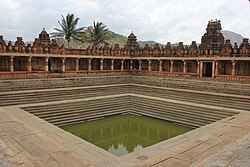](/wiki/File:Temple_tank_in_Bhoganandishvara_group_of_temples_at_Chikkaballapur_district.JPG)
Temple tank in [Bhoga Nandeeshwara Temple](/wiki/Bhoga_Nandeeshwara_Temple "Bhoga Nandeeshwara Temple") at Chikkaballapur district, Karnataka.
**Temple tanks** are [wells](/wiki/Water_well "Water well") or [reservoirs](/wiki/Reservoir "Reservoir") built as part of the temple complex near Indian temples. They are called pushkarini, kalyani, kunda, sarovara, [tirtha](/wiki/Theertham "Theertham"), talab, pukhuri, ambalakkuḷam, etc. in different languages and regions of [India](/wiki/India "India"). Some tanks are said to cure various diseases and maladies when bathed in.[[ssv.asia_Sprawling_high-concept_cinematic_YouTube_channel_banne_4611d8c6-78a9-4cc4-9c4d-4896fb37d53d__1_-removebg-preview.png]](#cite_note-1) It is possible that these are cultural remnants of structures such as the [Great Bath](/wiki/Great_Bath,_Mohenjo-daro "Great Bath, Mohenjo-daro") of [Mohenjo-daro](/wiki/Mohenjo-daro "Mohenjo-daro") or [Dholavira](/wiki/Dholavira "Dholavira"),[[Building Back Better (2)]](#cite_note-news-2) which was part of the [Indus Valley civilization](/wiki/Indus_Valley_civilization "Indus Valley civilization"). Some are [stepwells](/wiki/Stepwell "Stepwell") with many steps at the sides.
Since ancient times, the design of water storage has been important in India's temple architecture, especially in western India where dry and monsoon seasons alternate. Temple tank design became an art form in itself.[[ssv.asia_Sprawling_high-concept_cinematic_YouTube_channel_banne_4611d8c6-78a9-4cc4-9c4d-4896fb37d53d__1_-removebg-preview.png]](#cite_note-3) An example of the art of tank design is the large, geometrically spectacular Stepped Tank at the Royal Center at the ruins of [Vijayanagara](/wiki/Vijayanagara "Vijayanagara"), the capital of the Vijayanagara Empire, surrounding the modern town of [Hampi](/wiki/Hampi "Hampi"). It is lined with green [diorite](/wiki/Diorite "Diorite") and has no [drain](/wiki/Plumbing_fixture#Inlets_and_drains "Plumbing fixture"). It was filled by [aqueduct](/wiki/Aqueduct_(water_supply) "Aqueduct (water supply)").[[ssv.asia_Sprawling_high-concept_cinematic_YouTube_channel_banne_4611d8c6-78a9-4cc4-9c4d-4896fb37d53d__1_-removebg-preview.png]](#cite_note-4)
The tanks are used for ritual cleansing and during rites of consecration. The water in the tank is deemed to be [sacred water](/wiki/Sacred_waters "Sacred waters") from the [Ganges River](/wiki/Ganges_River "Ganges River").[[ssv.asia_Sprawling_high-concept_cinematic_YouTube_channel_banne_4611d8c6-78a9-4cc4-9c4d-4896fb37d53d__1_-removebg-preview.png]](#cite_note-5)
In India, a [stepwell](/wiki/Stepwell "Stepwell") is a deep masonry well with steps going down to the water level in the well. It is called a *vav* in west India and a *baoli* in north India. Some were built by kings and were richly ornamented.[[ssv.asia_Sprawling_high-concept_cinematic_YouTube_channel_banne_4611d8c6-78a9-4cc4-9c4d-4896fb37d53d__1_-removebg-preview.png]](#cite_note-6) They often were built by nobility, some being for secular use from which anyone could obtain water.[[ssv.asia_Sprawling_high-concept_cinematic_YouTube_channel_banne_4611d8c6-78a9-4cc4-9c4d-4896fb37d53d__1_-removebg-preview.png]](#cite_note-7)
**Kalyani**, also called ***pushkarani***, are ancient [Hindu](/wiki/Hindu "Hindu") stepped [bathing](/wiki/Bathing "Bathing") wells.
These wells were typically built near [Hindu temples](/wiki/Hindu_temple "Hindu temple") to accommodate bathing and cleansing activities before prayer. They are also used for immersion of [Ganesha](/wiki/Ganesha "Ganesha") idols during [Ganesha Chaturthi](/wiki/Ganesha_Chaturthi "Ganesha Chaturthi").
In [Sikhism](/wiki/Sikhism "Sikhism"), temple tanks are called *sarovar* (Punjabi: ਸਰੋਵਰ *sarōvara*).[[ssv.asia_Sprawling_high-concept_cinematic_YouTube_channel_banne_4611d8c6-78a9-4cc4-9c4d-4896fb37d53d__1_-removebg-preview.png]](#cite_note-Harban_Singh_1998-8)
* C.P.R. Environmental Education Centre (2002). *Sacred tanks of South India*. pp. 328.
